Showing all 17 resultsSorted by latest
-
 $115.00
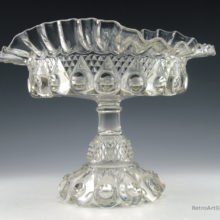
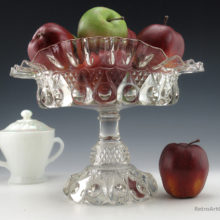
Large Victorian Glass Footed Table Bowl
Victorian glass centerpiece bowl in the Reverse Torpedo, also called Bulls-Eye and Diamond Point, circa 1891. The pattern was made in an extended table service of many forms but it is a challenging and scarce pattern to collect. It was produced by Dalzell, Gilmore & Leighton (pattern no. 49), early fore bearers of the pressed glass industry in the USA.
Near the end of the Victorian Era, pressed glass was a partially automated process overcoming the high cost of household glass and making it available to a broader market. Beautiful bowls like this graced many a Victorian home.
Glass over 70 years old is officially considered antique. Normal antique age is 100 years or older. Glass gets 30 years off because of it’s high rate of breakage. This old beauty is about 120 years old and in very fine condition. There are no chips or cracks, the glass is clean and brilliant with no signs of purpling. The base bears a solid ring of bottom-wear, appropriate for its age and weight.
Made with thick high clarity glass. The pattern is deep and 3-dimensional. The base and bowl were made separately and applied with molten glass. The ruffle rim was hand-tooled and heat-polished. Stands 9″ tall with an 11″ x 8″ oval bowl. Weighs just under 4 lbs.
-
 $65.00
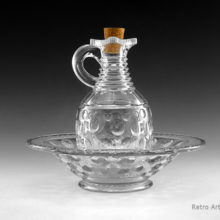
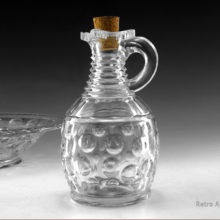
Interesting set of Early American pressed glass with a concave circle pattern. It is a ‘Thousand Eye’ type, reflects the circles within the circles. We have not found a positive identification of the pattern.
The bowl was formed with a four-part mold and is in perfect condition. The jug was blown into a two-part mold with pontil evidence on the base. The jug has a horizontal sharp ringed neck. The rim has sharp vertical ridges and a flat 4-corner spout. There is a tiny imperceptible sliver chip on top-flat surface of the 4-corner rim. Both items were finished with fire-polishing.
Bowl measures 7″ round and 2″ tall. Cruet sized jug is 5¾” tall. Cork is not original (lol). The jug probably had a matching stopper when produced.
Circa estimated to the EAPG era, 1850 to 1910. Probably American made, but could be Irish.
-
 $165.00
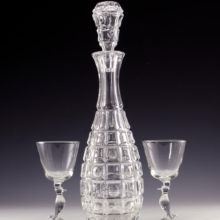
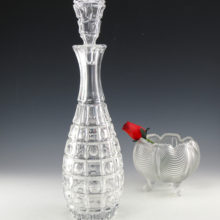
Grand Antique Crystal Decanter in Block and Thumbprint Pattern
Large antique crystal decanter with original hollow, ground to fit stopper. Made of quality, thick leaded crystal. Weighs 4 Lbs. Stands 15″ tall.
Possibly made by Duncan Glass or Columbia Glass if produced in the U.S., but could be of European make. Both U.S. companies offered a Thumbprint Block pattern. This decanter’s pattern is unusual with alternating smooth blocks and blocks with thumbprints.
Estimated circa late 1800’s to early 1900’s. Black light test shows no evidence of manganese (a mineral used to replace lead during wartime) so we are assuming it was made between wars. It is pressed and polished lead crystal. Has an Art Deco styling but may be Late Victorian.
In excellent condition. Sparkling clean inside and out. Stopper is ground to fit. Rim is hand-polished. No seams. Beautiful, majestic addition to your bar.
A companion decanter with the same pattern by the same maker, but with a different form, is also available (shown in image 7). Click here to view the companion ship decanter.
-
 $160.00
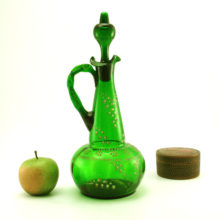
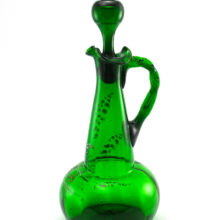
Victorian glass decanter in emerald green with hand-applied enamel decor. Large Handled jug with original stopper.
Antique decanter with enamel decor, probably of Bohemian (French or Czech) or could be English origin. It is hand-signed in gold on the base with a notched cursive L followed by a floating dot. Victorian Era or older.
To this date, we have not identified the “L” signature and we find that very odd! Perhaps it is not an “L”? We have another very old decanter and goblet signed the same, click here to view. If anyone can help with the ID, please email retroartglass@retroartglass.com .
The stopper is hand-formed and hollow with two intentional teardrop bubbles. The pontil scar is rough ground and inverted. The vessel was hand-blown from optic mold. The base of the decanter has optic panels. The handle was drawn by hand, crimped by tool and applied to the vessel. Stopper insert and neck are ground to fit. Original stopper.
The decanter base does not have calcium deposit damage. In image 7 (showing the rough pontil), notice the interior looks dirty. This is due to the reflections of the air bubbles trapped within the glass, the enamel decor showing through, and the remnants of a base protector. A fine layer of dust inside the vessel base can be seen. This dust, and the remnants of the base protector will be removed. No chips, no cracks. The hand-applied floral decor shows wear with about 90% of the enamel still present.
Large antique emerald green decanter measures 13″ tall with stopper.
-
 $400.00
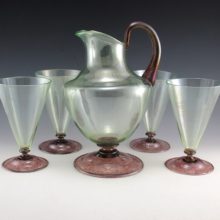
Antique Venetian hand blown glass pitcher jug and four flute goblets.
Exquisite antique Venetian mouth blown glass by a master of the craft. Estimated circa; early 1900’s. We have not identified it yet, but have many clues. We are certain this set is not of modern make. The shape and decor have a story to tell.
The set of four goblets and pitcher and appears to be from the late 19th to early 20th century Italy. The style and form were revived from ancient glass examples excavated during the Renaissance by great maestros of glass in the 1700 and 1800’s whose names and achievements still live on today.
The large antique Venetian pitcher and goblets were mouth blown in a slightly iridescent, very light airy green. The light green glass lights up neon green under black-light, indicating the presence of Manganese or Uranium.
The pitcher leans forward, as in ancient days. This feature assisted the hostess or servants while tipping the large pitcher for service. This pitcher should always be lifted in this manner to avoid damage to the handle.
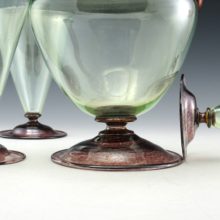
The mottled plum base and stretch satin handle are hand-formed, each with a different decor style, and applied to the pitcher’s body. The inverted dome feet/bases are mottled clear and plum glass with folded up rims. Pontil scars located on inner domed feet are slightly rough. The goblet rims are folded up. The hand drawn and stretched handle is in mottled plum and clear glass with added decor of fumed iridescence. It’s as soft as velvet and shimmers and shines.
A tiny chunk of coal from the glass furnace is trapped within this vessel’s handle (see image). Coal from an old fashioned furnace trapped within the glass is a sure sign of age.
A double wafer knop is applied to base and vessel, joining the two. The large handle is applied. It hoops well above the body. This large jug is meant to be held with two hands. One hand on the handle, the other flat out on the opposite side on the body.
It is in wonderful shape with no cracks or chips or liquid damage. The pitcher is perfect. The goblets have very slight minimal scratching on the interior probably due to stir sticks.
Pitcher is 10″ tall, 6.5″ at widest with a widest girth of 19″. Pitcher’s foot is 5.25″ wide. The four flute goblets measure 6″ tall, mouth opening width of 3.75″ and foot width of 3.25″. Large tumblers – full-sized. Set includes one large pitcher and FOUR large fluted goblets. Sparkling clean.
The form, style and decor of this antique Venetian beverage set lead us to the path of Compagnia di Venezia e Murano and down the path to Pauly & C. You can read more via the links below.
According to Wikipedia:

Pitcher made by Vittorio Zecchin with fumed handle, domed and folded foot, leaning slightly forward. Compagnia di Venezia e Murano began as Salviati &C. in London in 1866 under the direction of Vicenza attorney Antonio Salviati and with the backing of two British men: archaeologist Austen Henry Layard and antiquarian Sir William Drake. The company was dedicated to using ancient techniques and utilized master glassblowers in its efforts to do so. Read More…
-
 $130.00
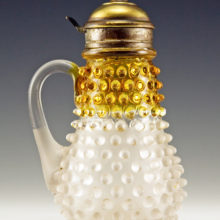
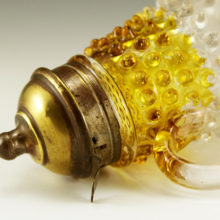
Hobbs Brockunier Frances Ware Antique Syrup Pitcher
Antique syrup pitcher from the Frances Ware line by Hobbs Brockunier. Turn of the century American art glass, circa late 1800’s. ‘Francis Ware’ was named after Grover Cleveland’s (USA President) wife Frances Folsom.
Beautiful Early American Pattern Glass (EAPG) hobnail pattern with a satin frost acid treatment on the lower half and a bright glowing amber on the upper portion. Hobbs Brockunier made quite a few table items in this pattern. Hard to find, but a real pleasure to collect.
Many Frances Ware items found today have chipped hobnails from bumping into other table items over the last 100+ years. This old stunner has only 1 small chigger on one hobnail on the body of the pitcher. On the base, the seat of the pitcher, there are approximately 8 chiggers off the last two rings of hobnails. These chiggers are invisible unless the pitcher is turned upside-down. They were caused by surface wear. See image 4.
The antique syrup pitcher has a pewter lid with 2 visible dents on the finial. The lid is intact and secure. Thumb tab flips up the lid to reveal a pouring spout. The lid seems to have a spring type control that provides tension while opening and it insures the lid shuts when the thumb pressure is removed. Whatever hardware used for this upgrade function is hidden within the thick walls of the cap.
The glass is sparkling clean with no residue stains. The solid glass handle was applied to the body. Made by hand over 100 years ago. Measures 7″ tall, 4½” at widest.
Shown in The Collector’s Encyclopedia of American Art Glass on page 74.
-
 $145.00
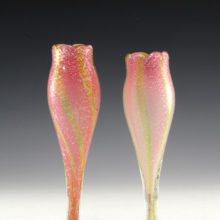
Antique Venetian Art Glass Hand-Blown Vanity Vase Set with Silver Aventurine
Darling antique Venetian art glass vase set made by hand in Venice, Italy. They appear to be very old, possibly late 1800’s. Both in excellent condition.
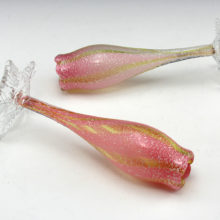
Made of quality cased crystal. Inner layer of pink and green color with sparking silver aventurine. The vases are thick-walled with drawn stems. Applied hand-tooled crystal leaf bases have been ground to sit flat. Small bits of furnace debris can be seen within the glass. Furnace debris is often found in antique glass because they used open furnaces and organic fuel. In excellent condition.
Made completely by mouth and hand. One is slightly taller than the other. Both stand straight upright, the smaller appears to slant in the images, but it doesn’t slant, it’s a side-effect of imaging. They are not perfect in shape, but this is due to very old hand-made glass methods.
Beautiful for the vanity. Tallest is 7 3/8″, smaller stand 7″ tall. Both in excellent condition.
-
 $55.00
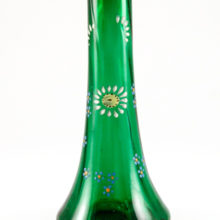
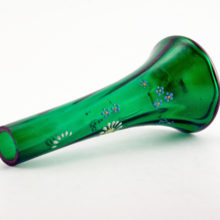
Small and fanciful antique Victorian whimsy enameled crystal vase.
Petite Victorian whimsy vase was exported from England during a time when the Crown was taxing crystal. Until the mid 1800’s England taxed leaded glass by weight. To continue profitable exports, English glass makers made glass objects smaller to lower the tax obligation. This beautiful little ‘whimsy’ vase is a result of England’s high taxes on export glass.
This beautiful Victorian era vase was made of quality hand-blown emerald lead crystal with delicate hand-painted enamel flowers. Measures 6½” tall on a 3″ wide base. No damage or wear. Some light residue trapped inside near the base. 3/4″ wide neck opening perfect for single rose or 2-3 daisies.
-
 $220.00
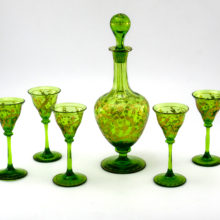
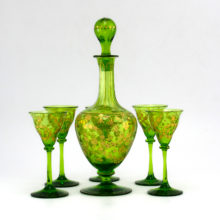
Antique Emerald Decanter and Goblets Engraved and Gold Filled
Fascinating antique emerald decanter with 5 liqueur goblets. Hand-blown, hand-cut and hand-decorated with thick gold fill. The floral decor was cut into the glass by hand and then filled with gold impasto (made with real gold). It is stunningly beautiful in style and craftmanship.
Maker is unknown, but suspected to be a French Saint Louis Cristallerie early 1900s liqueur set. The decor was first cut into the glass, then inlaid with gold to the surface (the gold is not raised from the surface) which is a Saint Louis Cristallerie known decor method. It’s a reverse impasto. The Art Nouveau styling is unmistakable. Cut oval ring on the base of the foot, filled with gold, is another feature found on very old Saint Louis glass. Actual maker is unknown, unable to verify at this time.
St Louis glass used paper labels to identify their glass prior to 1925 when they began permanent marking with an acid etch. This set has no labels or markings. You can read more about Saint Louis Cristallerie at Wikipedia. The Widipedia article is in German, so you’ll have to use the translator to read it. See this Saint Louis Cristallerie set at LR Antiques. Notice the decor closeups.
The emerald glass is in perfect sparkling condition. There are no chips. The gold fill ranges from 50 to 100%. See closeup images and captions. The gold fill in the circle of engraved ovals on the base of the foot has mostly worn, but two have much remaining. The rim gold is in worn to very good condition. The entire set was hand-blown, hand-decorated and hand-finished.
The decanter was blown, engraved and filled with gold. The decanter base was made separately and applied to the vessel. The stopper is hand-formed, with a bubble inside, hand-cut and inlaid with gold. The goblet vessels were blown and applied to drawn stem and foot, carved and gold inlaid. Only five goblets have survived of what was once a set of 6.
Stunningly beautiful, historic set. A masterpiece by an early European maker for sure. Decanter is 9.5″ tall, goblets are 4.5″ tall
-
SOLD
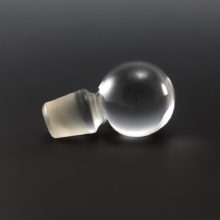
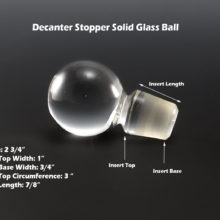
Small crystal ball stopper will fit smaller decanters, cruets, jugs and perfume bottles.
Made of solid glass with a few trapped air bubbles in the ball. In excellent condition.
Use the measurements shown in the image to determine if this small crystal ball stopper will fit your container.
To determine if your stopper will fit your bottle:
Replacing missing stoppers is tricky. A good fit is essential. The measurements must match perfectly to the bottle neck opening in order to seal the air out and sit upright (without wiggling). Replaced stoppers are referred to as “married”, meaning the stopper is not original to the bottle.
- Measure the inner diameter of bottle neck opening. Use a soft tape measure to determine the width of the top opening. Measure the open space only, between the bottle neck opening. Do not include the glass rim of the bottle neck.
- The stopper’s ‘insert top’ (see image with measurements) should match the inner diameter (width) of the bottle neck opening exactly or just very slightly smaller. You can use your soft measuring tape to encircle the inner top opening to obtain the circumference.
- Most decanter bottle necks taper slightly down toward the vessel, resulting in a smaller neck measurement than the bottle neck opening. You should know the length of the insert. The insert is the portion of the stopper that enters the bottle neck opening.
- Take the measurement of the stopper’s insert length, from base to top of insert, and use your soft tape measure to determine where the stopper base will rest in your bottle neck. The stopper’s ‘insert base’ should measure exactly or just very slightly smaller than the measurement of the area of the bottle neck where it will rest when inserted.
Most stoppers made for the decanters from the past have a ground area encircling the stopper base. These stoppers have been ‘ground to fit’ by the maker for the exact bottle they were made for. If you know how to grind glass, or know someone who does, you can have your stopper altered to fit your bottle. This can be done only with stopper inserts that are slightly larger than the bottle neck.
Trying to get a perfect ‘marriage’ between a vintage glass decanter and replacement stopper is not easy. Often, even when the measurements match up, the stopper will tend to lean or wiggle. If your decanter is for decor purposes only, and you do not plan on using it as a decanter, you can put a small blob of putty or wax on the inner neck of the bottle to stabilize the stopper.
Click here to view all the marriageable stoppers available at Retro Art Glass.
-
 $425.00
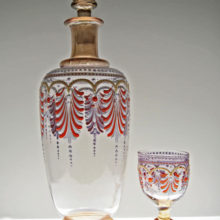
Antique enameled glass decanter and Goblet Signed L.
Well-preserved antique Bohemian glass hand-blown decanter and goblet with enamel decor . Very rare. Very old.
This antique decanter set is probably of Bohemian origin, possibly Joseph Lobmeyr or his son Ludwig (Vienna, Austria) . It is signed in gold with a notched cursive L preceded by a floating dot and followed by a period on the base of the decanter. May be of English origin, as the exact style of palm fan decor on these items match that used by Thomas Webb in the 1870’s. Victorian Era or older…has a Renaissance look to it.
To this date, we have not identified the “L” signature and we find that very odd! Perhaps it is not an “L”? If anyone can help with the ID, please email retroartglass@retroartglass.com. We have another antique decanter in emerald green with the “L”? makers mark, click here to view.
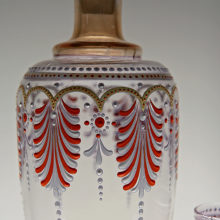
Heavy hand-painted enamel decor of drapes, dots and fans/palms of Islamic inspiration. The thick, bright orange, yellow and white enamel decor is absolutely perfect, 100%, no damage, no wear.
The translucent glass is light amethyst. The very faint purple tint to the glass may be the intention of the artist, but most likely due to a “sun purple” effect which would develop naturally over the decades. The glass glows light neon green under black light.
The hollow stopper (original to bottle), neck, hollow base and goblet stem are in gold luster. The luster shows some wear, some pinholes, some areas of lightening, but is 95% present. Great condition for its age. The small wine glass did not receive it’s final grinding on the outer foot edge, making the rim around the foot rough, not chipped. Fired polished rims are slightly uneven, expected from old hand-blown glass. The pontil scar is rough ground.
The decanter’s inner hollow base has some residue that will come out with further detailing. The glass has NO hazing or calcium deposits. No chips, no cracks.
Large decanter measures 11.5″ tall with stopper. Stemmed goblet is 4″ tall. Stopper and decanter neck are ground to fit. Stopper is hollow. Exceptional.
Victorian Glass Decanter Large with Handle, Stopper, Enamel Decor, Signed L.
-
 $95.00
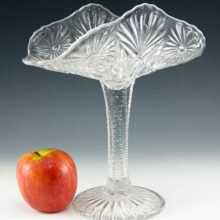
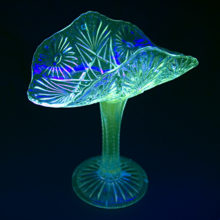
Beautiful late Victorian era glass table centerpiece compote.
Victorian era glass long stemmed banana boat in excellent condition. A bunch of bananas fit perfectly, but works great with other fruits or food.
Similiar to Bryce Higbee patterns of the early 1900s. The flower-like sunrays, fans and zippers do not exactly match Higbee’s published patterns, and the glass feels and looks different. I believe it is older, around 1880 EAPG or possibly European.
The colorless, nearly white, crystal is peppered with hundreds of very tiny bubbles. The glass is heavy with a velvet smooth feel. It glows green under blacklight. Would turn purple if left exposed to ultra-violet light.
This beauty has been well-preserved with no hints of purple at all. The elaborate Sunray foot shows 4 mold lines. The mold lines on the stem are lost in the zippers. The pressed bowl was stretched and finished by hand with no mold lines visible. Looks like Sandwich type glass. The exterior pattern on the bowl is raised and the interior pattern is smooth with slight indents along the pattern.
Measures just under 9″ tall, 8.25″ long and 4.75″ wide. Weighs 2 lbs. Solid circle of bottom-wear on the base as expected on antique glass.
-
 $225.00
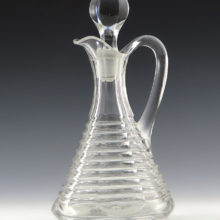
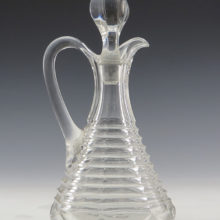
Heisey Prison Stripe attern #357 antique crystal oil cruet with original stopper.
Very hard to find pattern and form made by Heisey in the U.S.A. for only 5 years. Circa 1904 to 1909. The pattern is also known as Horizontal Stripes.
Only 32 items (forms) were made in this pattern. This is an oil or vinegar cruet. Especially rare form, with original stopper. Book value in 2001 for this lovely scarcity is $275.00.
Blown into mold with thick, heavy quality glass. The pattern is very deep. Appears cut. The base shows the pontil scar. Handle was hand-pulled and applied.
It is in remarkably fine condition for its age and rarity. A smooth sliver chip can be felt beneath the spout lip. It cannot be seen without inspecting very closely. The original stopper has some small chiggers on the tip. Very light liquid residue on inside base only. Barely visible. No chips or chiggers to the body.
Measures 7.5″ tall. Very rare and special gift for your favorite antique glass cruet collector!
Read more about Heisey at Wikipedia
-
SOLD
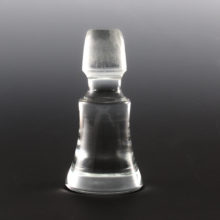
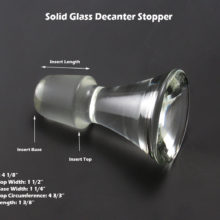
Glass bell decanter stopper made of solid glass. Colorless, will go well with any large decanter, jug or bottle.
Solid glass Bell decanter stopper measures 4¾” long. See image for exact measurements.
In excellent condition. Beautiful clarity. We have another bell stopper which is slightly smaller than this one.
To determine if this glass bell decanter stopper will fit your bottle:
Replacing missing stoppers is tricky. A good fit is essential. The measurements must match perfectly to the bottle neck opening in order to seal the air out and sit upright (without wiggling). Replaced stoppers are referred to as “married”, meaning the stopper is not original to the bottle.
- Measure the inner diameter of bottle neck opening. Use a soft tape measure to determine the width of the top opening. Measure the open space only, between the bottle neck opening. Do not include the glass rim of the bottle neck.
- The stopper’s ‘insert top’ (see image with measurements) should match the inner diameter (width) of the bottle neck opening exactly or just very slightly smaller. You can use your soft measuring tape to encircle the inner top opening to obtain the circumference.
- Most decanter bottle necks taper slightly down toward the vessel, resulting in a smaller neck measurement than the bottle neck opening. You should know the length of the insert. The insert is the portion of the stopper that enters the bottle neck opening.
- Take the measurement of the stopper’s insert length, from base to top of insert, and use your soft tape measure to determine where the stopper base will rest in your bottle neck. The stopper’s ‘insert base’ should measure exactly or just very slightly smaller than the measurement of the area of the bottle neck where it will rest when inserted.
Most stoppers made for the decanters from the past have a ground area encircling the stopper base. These stoppers have been ‘ground to fit’ by the maker for the exact bottle they were made for. If you know how to grind glass, or know someone who does, you can have your stopper altered to fit your bottle. This can be done only with stopper inserts that are slightly larger than the bottle neck.
Trying to get a perfect ‘marriage’ between a vintage glass decanter and replacement stopper is not easy. Often, even when the measurements match up, the stopper will tend to lean or wiggle. If your decanter is for decor purposes only, and you do not plan on using it as a decanter, you can put a small blob of putty or wax on the inner neck of the bottle to stabilize the stopper.
Click here to view all the marriageable stoppers available at Retro Art Glass.
-
 $200.00
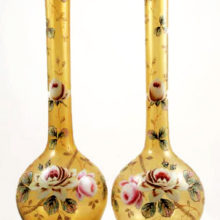
Majestic Victorian blown glass vases stand 16.75″ tall.
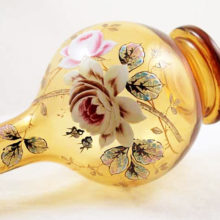
Offered as a set of two. Victorian blown glass mantel vases, circa 1880’s. Hand blown and hand decorated in a Charleton Rose type decor (very popular in the day).
Both in almost like-new condition. No chips or cracks on the glass. No liquid stains. The enamel is still bright and slightly raised from the surface. There are only a couple, very tiny, almost invisible, enamel misses. The only real wear to these beauties is on the surface of the flat polished beveled rim which had a layer of gold that has nearly worn off.
Hand-blown glass is never identical. These are very close to identical with the only visible difference showing in the bases. One base is thicker than the other. The hand-painted enamel was applied using a stencil as a guide. There are differences in the flowers, because it is hand done, but it is unnoticeable.
The shape was blown and then cut at the rim. A punty mark (where the glass blower held the glass with his tool) is slightly inverted on the base. The bases have a solid band of bottom-wear caused by sitting on a surface for over 100 years, this is expected and not considered damage.
Probably made in Europe. May have been made in America by early Cambridge glass whose designs mirrored those popular in Europe and extensively used the Charleton Rose style decor.
-
 $115.00
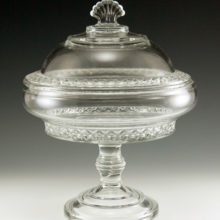
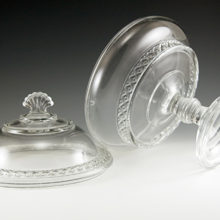
EAPG Glass Covered Comport in Spirea Band Squared Dot Pattern by Bryce
Big early American pressed glass covered comport by Bryce Higbee, circa 1885. In beautiful shape, no damage. The only sign of wear is the solid ring of bottom-wear on the base where it has rubbed against the surface for about 130 years.
This type of glass would ‘purple’ if left in direct UV light. It takes on a green glow under black-light. ‘Purpling’ is considered damage by most collectors. This beauty has no hint of purple. The glass is colorless and sparkling clean. Unusual to find an item like this with the matching lid in great condition.
Large EAPG covered comport measures 9½” tall and 8″ at widest. Widest girth is 24″. Weighs almost 3 lbs. Will hold lots of goodies, and is large enough to hold a side-dish, fruit, etc.
Made with a 3-part mold. Pattern called Spirea Band Squared Dot by Bryce Higbee.
-
 $55.00
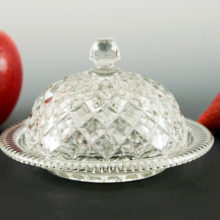
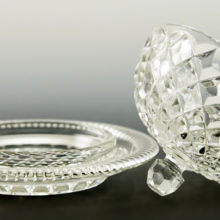
Diamond Block Covered Butter Dish – Antique Flint Glass
Antique flint glass covered dish made during the Early American pressed glass period (EAPG 1825 – 1910). Homemakers, servants and/or slaves made their own butter from milk. It was a time consuming process and butter was considered a luxury food. Beautiful dishes were made to present the butter at the dining table. This rare table service butter dish is an excellent example.
Probably made by George Duncan & Sons / U.S. Glass circa 1880, pattern called Diamond Block, also known as Diamond Waffle, also known as Patricia. Other possible makers are Westmoreland Glass, pattern Gillinder, circa 1889; and Heisey made a limited pattern like this called ‘mitered diamond’. The shape of the knob points directly to Duncan and we are 90% sure it is by Duncan.
Made of ‘White Glass’, a term used to describe antique flint glass. Flint glass is a very hard glass, and reflects a white sparkle. If broken, it separates into chunks. Usually made with quartz in the recipe.
Table service butter dishes are sized-down to accommodate about 1/4 lb. Doubles as a cheese, cavair, etc. server. This scarce beauty measures 5″ round and 3″ tall, weighs 1 lb. It is in near perfect condition. Amazing. The only sign of age is the thick, complete band of bottom-wear (from surface contact) on the seat ring and a small thin sliver off the inner bowl ring which holds the dome in place. Nearly invisible but can be felt. Dome was made with a 4-part mold, base was pressed.