Showing all 16 resultsSorted by latest
-
 $160.00
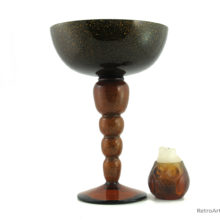
Very large spangled glass goblet hand-blown in amber, black and laden with gold.
This vintage or antique hand-crafted art glass ceremonial goblet is made with high quality crystal and weighs 3½ pounds. Stands 11¼” tall with a 8″ wide bowl.
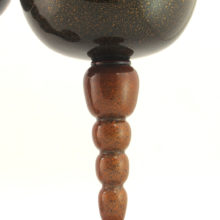
The blown bowl is made with black crystal and heavy gold or copper aventurine or ‘spangle’ embedded within the glass. The applied hand-worked stem is made with amber crystal loaded with aventurine. The applied foot is in amber crystal.
Exceptional and unusual oversize art glass goblet. Made of quality colored crystal. Rings like a bell. Because real crystal, made with lead, is rarely used today we believe this beautiful creation is of at least vintage age. The rich decor of ample aventurine is also not made much today.
The base of the foot has very little bottom-wear. We expect to see at least medium bottom-wear on heavy vintage glass items, but this goblet’s base was protected, or rarely moved.
It has the Venetian/Murano glass appeal and feel, but may be American blown spangled glass. Hobbs Brockunier made some hand-blown items with the same colors and decor, but that was back in the mid-1800’s.
Large highly designed art glass goblets forms like this were used as ceremonial goblets. This stunner is a stand-alone decor eye-grabber. Would look beautiful with a artificial draping plant or floral in the cup.
In great condition. Glass is free of water stains. Shines brilliantly. The hand-polished rim of the bowl has one nick that can be felt when running a finger around the rim. It’s so slight that it cannot be seen or imaged, but can be felt.
Maker and age unknown at this time. Estimated circa 1850 to 1960.
-
 $15.00
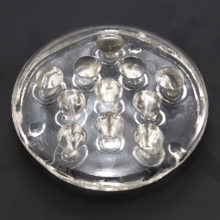
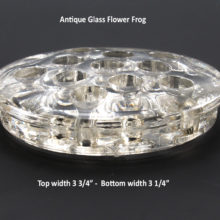
It is important the measurement of the flower frog match your intended use. This antique glass flower frog is rimmed so it can sit upon the rim of your flower bowl or vase, allowing the flower stems to be inserted through the open holes reaching down into the water. It can be placed in the base of a large bowl if you like. It was designed to float above the base of the vessel or sit inside a vessel. Has three little feet on the base to raise above surface when placed inside a flower vase or bowl.
Most agree these helpful flower arranging tools were called ‘flower frogs’ because they sit in water, like a frog. Flower frogs became widely popular in the US during the early 1900’s for use in flower arranging. The form and function was replaced In the mid 1950’s by a water-absorbent foam, stopping the development of glass flower frogs.
Glass flower frogs of yesteryear are a better choice than modern foam as they are re-usable, sturdy, collectible and beautiful in their own way. Click here to learn how to use flower frogs.
Retro Art Glass has a wide variety of flower frogs available, including more made with Uranium, click here to view the selection.
-
 $20.00
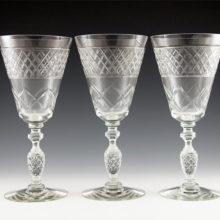
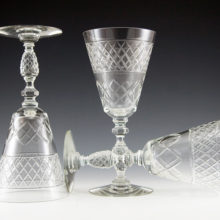
Beautiful old elegant fine cut crystal goblets by unknown maker. Listed in ‘Crystal Stemware Identification Guide’ as UNK302.
The big trumpet bowl is hand blown and cut with a wide band of crisscross and lower trim of large crisscrosses. The intricate stem was made with a 3-part mold. The foot was applied to the stem.
The pattern looks like Pairpoint Adelaide from the 1920’s. Adelaide is usually seen with a solid ball stem with air bubble inclusions. Also been seen with a rather plain square stem. The stem on these goblets have a pineapple type knop. The quality of this stemware matches that of the infamous Pairpoint.
Quality colorless fine cut crystal. Exceptional clarity. The crystal recipe contains Manganese, a mineral used to replace lead during WWI and WWII when lead was scarce. Manganese causes the glass to reflect greenish under black-light (image 3). Estimate circa 1910 – 1940.
Beautiful lingering tone when plinked. Each goblet weighs ½ lb. Stand 7½” tall. All three in perfect condition. Three are available, each selling separately. Choose your quantity above. Lovely as a gift with a bottle of fine wine.
-
 $160.00
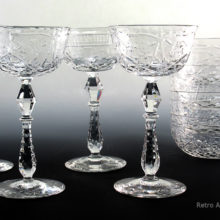
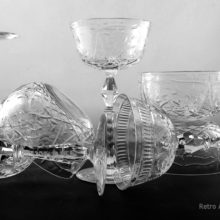
Antique cut crystal stemware and bowls set of 8.
This luxurious leaded crystal with superior cut decor is known as Libbey Rock Sharpe. Hand-blown and hand-cut crystal dates from the 1920’s to 1930’s.
The stem number is 1008-2 with brilliant jewel cut knops, chiseled stems and etched ovals on the foot. The stemware and bowls have optic panels, hand-cutting/engraving, and fire-polished finishing. Two of the cocktail goblets have a slightly different cut pattern.
Superb quality crystal. They produce long, lingering tones when plinked.
Libbey has a long and prolific history. Edward Libbey, known as the father of the U.S. glass industry, founded Libbey glass in 1888 after heading the New England Glass Company. Libbey was heralded for it’s superior quality glassware. Over the years Libbey adapted to the changing economy and market developing more affordable everyday glass forms. Libbey is still in business today, a miracle to be sure. Most U.S. glass makers of the past failed to adapt and went out of business before the 1980’s.
This 8-piece set consists of (4) 5¼” tall cocktail goblets and (4) 5′ round 3″ deep bowls. Acquire this luxury stemware and bowl set for your next intimate celebration!
All are in perfect condition.
-
 $165.00
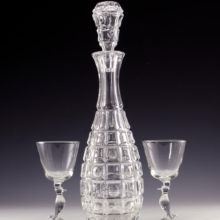
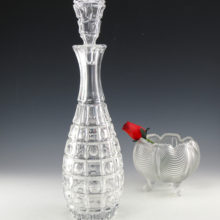
Grand Antique Crystal Decanter in Block and Thumbprint Pattern
Large antique crystal decanter with original hollow, ground to fit stopper. Made of quality, thick leaded crystal. Weighs 4 Lbs. Stands 15″ tall.
Possibly made by Duncan Glass or Columbia Glass if produced in the U.S., but could be of European make. Both U.S. companies offered a Thumbprint Block pattern. This decanter’s pattern is unusual with alternating smooth blocks and blocks with thumbprints.
Estimated circa late 1800’s to early 1900’s. Black light test shows no evidence of manganese (a mineral used to replace lead during wartime) so we are assuming it was made between wars. It is pressed and polished lead crystal. Has an Art Deco styling but may be Late Victorian.
In excellent condition. Sparkling clean inside and out. Stopper is ground to fit. Rim is hand-polished. No seams. Beautiful, majestic addition to your bar.
A companion decanter with the same pattern by the same maker, but with a different form, is also available (shown in image 7). Click here to view the companion ship decanter.
-
 $165.00
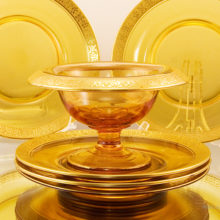
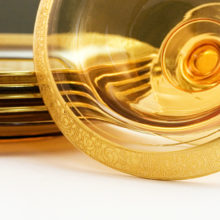
Very special gold encrusted antique dessert service set by Tiffin Glass. Circa 1920’s-1930’s.
Antique dessert service set of 6. All are hand decorated with real gold in the Rambler Rose pattern. The plates have polished seat rims. The blown compote has a pontil mark and applied stem.
Set includes (5) 7″ dessert plates and (1) dessert sauce compote. One of the dessert plates can serve as a liner for the compote. Aperitif goblet shown in images is not included.
Incredible find, such a beautiful nearly untouched set. The amber color of the glass is unusual as the Rambler Rose gold encrusted decor is usually found on clear glass. The amber color multiplies the elegance of this set. In excellent condition – the gold is thick and 98% present.
-
 $400.00
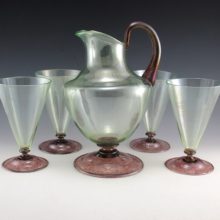
Antique Venetian hand blown glass pitcher jug and four flute goblets.
Exquisite antique Venetian mouth blown glass by a master of the craft. Estimated circa; early 1900’s. We have not identified it yet, but have many clues. We are certain this set is not of modern make. The shape and decor have a story to tell.
The set of four goblets and pitcher and appears to be from the late 19th to early 20th century Italy. The style and form were revived from ancient glass examples excavated during the Renaissance by great maestros of glass in the 1700 and 1800’s whose names and achievements still live on today.
The large antique Venetian pitcher and goblets were mouth blown in a slightly iridescent, very light airy green. The light green glass lights up neon green under black-light, indicating the presence of Manganese or Uranium.
The pitcher leans forward, as in ancient days. This feature assisted the hostess or servants while tipping the large pitcher for service. This pitcher should always be lifted in this manner to avoid damage to the handle.
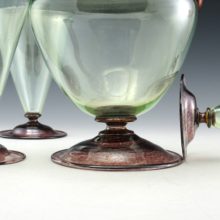
The mottled plum base and stretch satin handle are hand-formed, each with a different decor style, and applied to the pitcher’s body. The inverted dome feet/bases are mottled clear and plum glass with folded up rims. Pontil scars located on inner domed feet are slightly rough. The goblet rims are folded up. The hand drawn and stretched handle is in mottled plum and clear glass with added decor of fumed iridescence. It’s as soft as velvet and shimmers and shines.
A tiny chunk of coal from the glass furnace is trapped within this vessel’s handle (see image). Coal from an old fashioned furnace trapped within the glass is a sure sign of age.
A double wafer knop is applied to base and vessel, joining the two. The large handle is applied. It hoops well above the body. This large jug is meant to be held with two hands. One hand on the handle, the other flat out on the opposite side on the body.
It is in wonderful shape with no cracks or chips or liquid damage. The pitcher is perfect. The goblets have very slight minimal scratching on the interior probably due to stir sticks.
Pitcher is 10″ tall, 6.5″ at widest with a widest girth of 19″. Pitcher’s foot is 5.25″ wide. The four flute goblets measure 6″ tall, mouth opening width of 3.75″ and foot width of 3.25″. Large tumblers – full-sized. Set includes one large pitcher and FOUR large fluted goblets. Sparkling clean.
The form, style and decor of this antique Venetian beverage set lead us to the path of Compagnia di Venezia e Murano and down the path to Pauly & C. You can read more via the links below.
According to Wikipedia:

Pitcher made by Vittorio Zecchin with fumed handle, domed and folded foot, leaning slightly forward. Compagnia di Venezia e Murano began as Salviati &C. in London in 1866 under the direction of Vicenza attorney Antonio Salviati and with the backing of two British men: archaeologist Austen Henry Layard and antiquarian Sir William Drake. The company was dedicated to using ancient techniques and utilized master glassblowers in its efforts to do so. Read More…
-
 $145.00
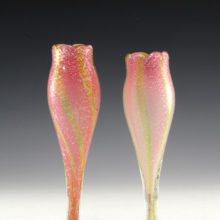
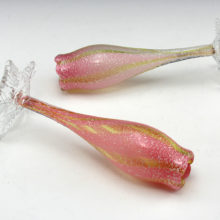
Antique Venetian Art Glass Hand-Blown Vanity Vase Set with Silver Aventurine
Darling antique Venetian art glass vase set made by hand in Venice, Italy. They appear to be very old, possibly late 1800’s. Both in excellent condition.
Made of quality cased crystal. Inner layer of pink and green color with sparking silver aventurine. The vases are thick-walled with drawn stems. Applied hand-tooled crystal leaf bases have been ground to sit flat. Small bits of furnace debris can be seen within the glass. Furnace debris is often found in antique glass because they used open furnaces and organic fuel. In excellent condition.
Made completely by mouth and hand. One is slightly taller than the other. Both stand straight upright, the smaller appears to slant in the images, but it doesn’t slant, it’s a side-effect of imaging. They are not perfect in shape, but this is due to very old hand-made glass methods.
Beautiful for the vanity. Tallest is 7 3/8″, smaller stand 7″ tall. Both in excellent condition.
-
 $220.00
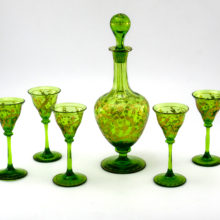
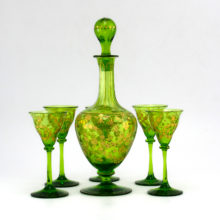
Antique Emerald Decanter and Goblets Engraved and Gold Filled
Fascinating antique emerald decanter with 5 liqueur goblets. Hand-blown, hand-cut and hand-decorated with thick gold fill. The floral decor was cut into the glass by hand and then filled with gold impasto (made with real gold). It is stunningly beautiful in style and craftmanship.
Maker is unknown, but suspected to be a French Saint Louis Cristallerie early 1900s liqueur set. The decor was first cut into the glass, then inlaid with gold to the surface (the gold is not raised from the surface) which is a Saint Louis Cristallerie known decor method. It’s a reverse impasto. The Art Nouveau styling is unmistakable. Cut oval ring on the base of the foot, filled with gold, is another feature found on very old Saint Louis glass. Actual maker is unknown, unable to verify at this time.
St Louis glass used paper labels to identify their glass prior to 1925 when they began permanent marking with an acid etch. This set has no labels or markings. You can read more about Saint Louis Cristallerie at Wikipedia. The Widipedia article is in German, so you’ll have to use the translator to read it. See this Saint Louis Cristallerie set at LR Antiques. Notice the decor closeups.
The emerald glass is in perfect sparkling condition. There are no chips. The gold fill ranges from 50 to 100%. See closeup images and captions. The gold fill in the circle of engraved ovals on the base of the foot has mostly worn, but two have much remaining. The rim gold is in worn to very good condition. The entire set was hand-blown, hand-decorated and hand-finished.
The decanter was blown, engraved and filled with gold. The decanter base was made separately and applied to the vessel. The stopper is hand-formed, with a bubble inside, hand-cut and inlaid with gold. The goblet vessels were blown and applied to drawn stem and foot, carved and gold inlaid. Only five goblets have survived of what was once a set of 6.
Stunningly beautiful, historic set. A masterpiece by an early European maker for sure. Decanter is 9.5″ tall, goblets are 4.5″ tall
-
 $60.00
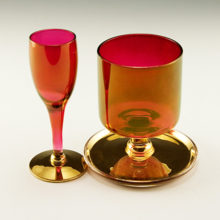
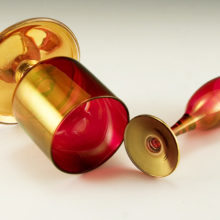
Antique elegant ruby blown glass with a golden glow.
Have a smoke and a little spirit in elegant style! Beautiful ruby blown glass goblet and cigarette or paraphernalia holder. Rich golden ruby color achieved using real gold from yesteryear.
In great + condition. It’s rare to find antique glass in this decor style without wear. This set is almost perfect with a few tiny pinholes and scratches of wear on the gold surface that cannot be seen unless held up to the light. The gold appears perfect under normal conditions. The flashed gold ruby is in excellent condition, bright and with a glowing gold reflection. No chips or cracks.
The cigarette holder style was made by elegant glass makers of the early 1900’s to the 1940’s. Looks like it may be by Cambridge Glass, an elegant maker of the era. This set is at least 70 years old.
The holder is 3.5″ tall with a 3.5″ base. Its turned up base was meant to be an ashtray, but don’t use it as one. The decor is delicate and will not hold up to grinding hot ashes into it. It could be used as a matchstick or other paraphernalia holder. The liquor glass stem is 4.25″ tall.
Both items are hand-blown with pontil marks. The bases are applied to the vessels. -
SOLD
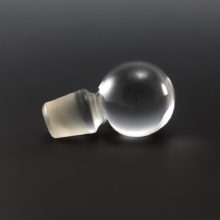
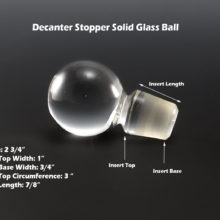
Small crystal ball stopper will fit smaller decanters, cruets, jugs and perfume bottles.
Made of solid glass with a few trapped air bubbles in the ball. In excellent condition.
Use the measurements shown in the image to determine if this small crystal ball stopper will fit your container.
To determine if your stopper will fit your bottle:
Replacing missing stoppers is tricky. A good fit is essential. The measurements must match perfectly to the bottle neck opening in order to seal the air out and sit upright (without wiggling). Replaced stoppers are referred to as “married”, meaning the stopper is not original to the bottle.
- Measure the inner diameter of bottle neck opening. Use a soft tape measure to determine the width of the top opening. Measure the open space only, between the bottle neck opening. Do not include the glass rim of the bottle neck.
- The stopper’s ‘insert top’ (see image with measurements) should match the inner diameter (width) of the bottle neck opening exactly or just very slightly smaller. You can use your soft measuring tape to encircle the inner top opening to obtain the circumference.
- Most decanter bottle necks taper slightly down toward the vessel, resulting in a smaller neck measurement than the bottle neck opening. You should know the length of the insert. The insert is the portion of the stopper that enters the bottle neck opening.
- Take the measurement of the stopper’s insert length, from base to top of insert, and use your soft tape measure to determine where the stopper base will rest in your bottle neck. The stopper’s ‘insert base’ should measure exactly or just very slightly smaller than the measurement of the area of the bottle neck where it will rest when inserted.
Most stoppers made for the decanters from the past have a ground area encircling the stopper base. These stoppers have been ‘ground to fit’ by the maker for the exact bottle they were made for. If you know how to grind glass, or know someone who does, you can have your stopper altered to fit your bottle. This can be done only with stopper inserts that are slightly larger than the bottle neck.
Trying to get a perfect ‘marriage’ between a vintage glass decanter and replacement stopper is not easy. Often, even when the measurements match up, the stopper will tend to lean or wiggle. If your decanter is for decor purposes only, and you do not plan on using it as a decanter, you can put a small blob of putty or wax on the inner neck of the bottle to stabilize the stopper.
Click here to view all the marriageable stoppers available at Retro Art Glass.
-
SOLD
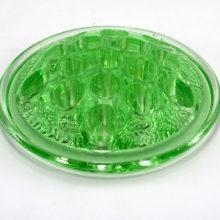
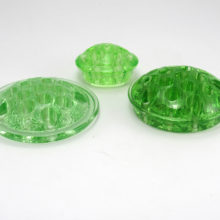
Large antique L.E. Smith Uranium glass flower frog was made in the 1920’s to 1930’s for assistance in flower arranging. The surface of the frog dome has little squiggly lines resembling hay. Made of Uranium glass which fluoresces bright glowing green under ultraviolet (black) light.The glass was created with Uranium to produce green colored glass at a time before Uranium was used for weapons. US production of Uranium glass ceased during World War II due to the US government’s confiscation of uranium supplies, and did not resume until 1958. After 1958, most Uranium glass objects were small figurines or reproductions of earlier antique forms. Read more about Uranium Glass.
This L.E. Smith Uranium glass flower frog was designed to sit upon the rim of your flower bowl or vase, allowing the flower stems to be inserted through the open holes reaching down into the water . It can be placed in the base of a bowl or vase if you’d like, as the rim will not prevent it, but it was specifically designed to float above the base of the vessel.
The L.E. Smith frog measures 4½” in diameter. The base is 4″ wide. Your flower vessel must have an 4″ wide opening for the frog to sit upon the rim. The frog has 16 holes. It is in perfect condition.
Most agree these helpful flower arranging tools were called ‘flower frogs’ because they sit in water, like a frog. Flower frogs became widely popular in the US during the early 1900’s for use in flower arranging. The form and function was replaced In the mid 1950’s by a water-absorbent foam, stopping the development of glass flower frogs.
Glass flower frogs of yesteryear are a better choice than modern foam as they are re-usable, sturdy, collectible and beautiful in their own way. Click here to learn how to use flower frogs.
Retro Art Glass has a wide variety of flower frogs available, including more made with Uranium, click here to view the selection.
-
 $45.00
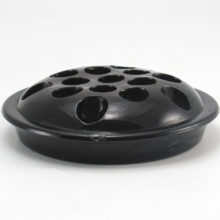
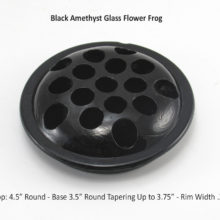
Large antique Black Amethyst glass flower frog was made in the 1920’s to 1930’s for assistance in flower arranging. It’s color is called Black Amethyst. It looks black, but is actually a very dark purple glass. In days gone by glass makers used dense purple or red glass to create black looking glass because they did not have a recipe for pure black glass.
This frog was designed to sit upon the rim of your flower bowl or vase, allowing the flower stems to be inserted through the open holes reaching down into the water . It can be placed in the base of a large bowl if you’d like, as the rim will not prevent it.
If you plan to use it as a rim balanced flower frog, your vessel opening rim must measure 3 ¼” to 4″ wide. The total width (diameter) of the round frog is 4½” wide. The frog rim is ¹⁄8″ inch wide. Stands 1¾” tall. The dome will rise above the level of the rim 1″. The flower stem holes are punched through (the punched through areas on the base reveal the true color, purple, when held to the light).
It weighs a tad over 1 lb. It is in great condition with one tiny sliver chip on the edge of the rim (view in image 1), no liquid stains.
Most agree these helpful flower arranging tools were called ‘flower frogs’ because they sit in water, like a frog. Flower frogs became widely popular in the US during the early 1900’s for use in flower arranging. The form and function was replaced In the mid 1950’s by a water-absorbent foam, stopping the development of glass flower frogs.
Glass flower frogs of yesteryear are a better choice than modern foam as they are re-usable, sturdy, collectible and beautiful in their own way. Click here to learn how to use flower frogs.
Retro Art Glass has a wide variety of flower frogs available, including more made with Uranium, click here to view the selection.
-
 $225.00
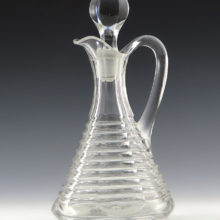
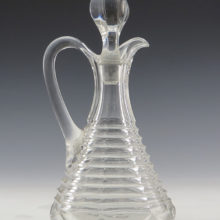
Heisey Prison Stripe attern #357 antique crystal oil cruet with original stopper.
Very hard to find pattern and form made by Heisey in the U.S.A. for only 5 years. Circa 1904 to 1909. The pattern is also known as Horizontal Stripes.
Only 32 items (forms) were made in this pattern. This is an oil or vinegar cruet. Especially rare form, with original stopper. Book value in 2001 for this lovely scarcity is $275.00.
Blown into mold with thick, heavy quality glass. The pattern is very deep. Appears cut. The base shows the pontil scar. Handle was hand-pulled and applied.
It is in remarkably fine condition for its age and rarity. A smooth sliver chip can be felt beneath the spout lip. It cannot be seen without inspecting very closely. The original stopper has some small chiggers on the tip. Very light liquid residue on inside base only. Barely visible. No chips or chiggers to the body.
Measures 7.5″ tall. Very rare and special gift for your favorite antique glass cruet collector!
Read more about Heisey at Wikipedia
-
SOLD
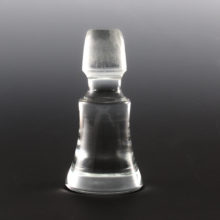
Glass bell decanter stopper made of solid glass. Colorless, will go well with any large decanter, jug or bottle.
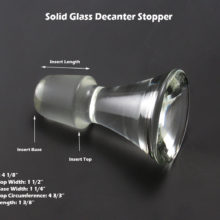
Solid glass Bell decanter stopper measures 4¾” long. See image for exact measurements.
In excellent condition. Beautiful clarity. We have another bell stopper which is slightly smaller than this one.
To determine if this glass bell decanter stopper will fit your bottle:
Replacing missing stoppers is tricky. A good fit is essential. The measurements must match perfectly to the bottle neck opening in order to seal the air out and sit upright (without wiggling). Replaced stoppers are referred to as “married”, meaning the stopper is not original to the bottle.
- Measure the inner diameter of bottle neck opening. Use a soft tape measure to determine the width of the top opening. Measure the open space only, between the bottle neck opening. Do not include the glass rim of the bottle neck.
- The stopper’s ‘insert top’ (see image with measurements) should match the inner diameter (width) of the bottle neck opening exactly or just very slightly smaller. You can use your soft measuring tape to encircle the inner top opening to obtain the circumference.
- Most decanter bottle necks taper slightly down toward the vessel, resulting in a smaller neck measurement than the bottle neck opening. You should know the length of the insert. The insert is the portion of the stopper that enters the bottle neck opening.
- Take the measurement of the stopper’s insert length, from base to top of insert, and use your soft tape measure to determine where the stopper base will rest in your bottle neck. The stopper’s ‘insert base’ should measure exactly or just very slightly smaller than the measurement of the area of the bottle neck where it will rest when inserted.
Most stoppers made for the decanters from the past have a ground area encircling the stopper base. These stoppers have been ‘ground to fit’ by the maker for the exact bottle they were made for. If you know how to grind glass, or know someone who does, you can have your stopper altered to fit your bottle. This can be done only with stopper inserts that are slightly larger than the bottle neck.
Trying to get a perfect ‘marriage’ between a vintage glass decanter and replacement stopper is not easy. Often, even when the measurements match up, the stopper will tend to lean or wiggle. If your decanter is for decor purposes only, and you do not plan on using it as a decanter, you can put a small blob of putty or wax on the inner neck of the bottle to stabilize the stopper.
Click here to view all the marriageable stoppers available at Retro Art Glass.
-
 $45.00
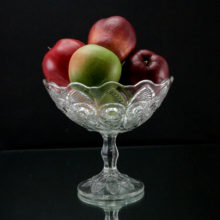
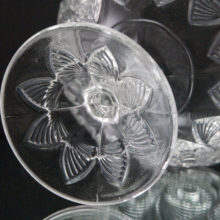
Antique Bullseye Fan centerpiece bowl circa 1907.
Bullseye Fan pattern glass by U.S. Glass, pattern no. 15090. Also known as Daisies in Oval Panels. Pattern designed in 1907. This is an original from the early 1900’s.
In wonderful condition. The only sign of age is the heavy ring of bottom-wear caused by over 100 years of surface contact. Glass is bright and sparkly. No chips.
Made with a 4-part mold. Contains three tiny air bubbles within the stem, commonly found in antique pressed glass. Beautiful pattern and uncommon form.
Measure 7.5″ wide and 7″ tall.