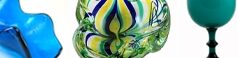

Mid Century Murano Art Glass Mushroom
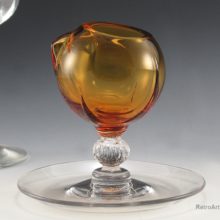
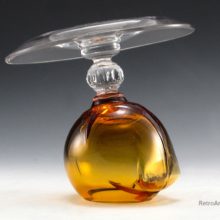
1950’s-1960’s Murano Cased Glass Mushroom in excellent condition. Inner ball of glass is bright orange. Large shroom, weighs 2 lbs, 3.25″ tall and 4″ wide. Wonderful hippy relic.
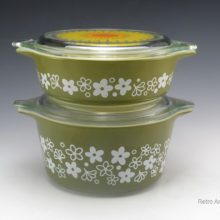
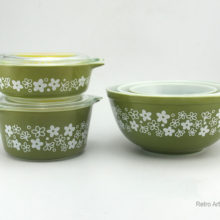
Set of two vintage Pyrex covered casseroles in Spring Blossom, known to collectors as Crazy Daisy.
The casserole dishes are part of line 470 described as Bake, Serve & Store. You can bake in them, then serve in them, then put the leftovers straight into the fridge.
Pyrex form part no. #473 & 471. Both dishes sport the Daisy promotional lids which are not original to the dishes. Good fit.. Made in the 1972 to 1981 by Anchor Hocking. Learn more about the Spring Blossom pattern and forms at the Corning Museum of Glass which produced an in-depth article specific to this pattern.
The decor was designed to be compatible with the Corelle Dinnerware of the same name. View Corelle Dinnerware offered by Retro Art Glass. View more Spring Blossom cookware offered by Retro Art Glass.
Both are in excellent condition, appear unused.
Great set of retro kitchen multi-purpose casserole dishes. Rare to find in this condition.
Rare Cambridge table glass ashtray and smoke holder, circa 1920’s. Identified as line #3400, part #144 in Colors of Cambridge Glass II by National Cambridge Collectors, on page 62. Described as “cigarette holder, Crystal stem and ashtray foot” and valued at $75.00, published in 2007 .
This lovely vintage table charm is more than just a cigarette holder with an ashtray foot. It has an incised slit near the top for a placeholder or gift card. The cigarette holder can double as a small vase. The ashtray foot can hold treats. Unique gift with a card, flowers (or small smokes) and sweets!
A must-have for collectors of elegant Cambridge glassware. It is in excellent condition.
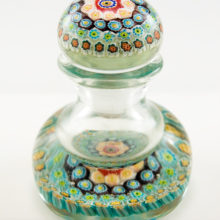
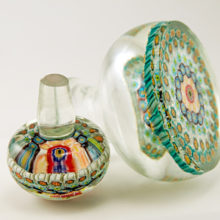
Made by one of England’s oldest and finest glassmakers called ‘Whitefriars’. First established by Carmelite Monks knowns as ‘White Friars’ in the 1600s, and finally closing its doors in the 1980s.This beautiful relic was made in the 1920s to 1930s by the Walsh Walsh or Arculus studios (part of Whitefriars). It is a large sized inkwell that has been used as such. There is a small stress mark on the bottom of the stopper’s insert (the part which goes inside the bottle), which can’t be seen and must be studied to detect. The ‘well’ has contained liquids in the past and has a light whispy film of liquid residue that will not clean off. Neither of these affect the integrity or the beauty of the glass. Only light bottom-wear, unusual as we would expect to see more bottom-wear on such a heavy piece. Overall outer appearance is excellent.
Completely hand-made. Heavy blown glass with a polished base. The decor was accomplished by hand-arranging small canes (millefiori) and encasing them within the colorless glass. The concentric millefiori decor is just above the base and near the top of the stopper. An optical illusion causes the millefiori to be seen at the base of the inner well, but this is just a reflection, and a very nice one too. The skilled glass artist has inserted tiny air-bubbles, also in a concentric pattern, between the canes. The stopper was made to fit, and with a turn will settle in and provide a good seal.Weighs 4.25 lbs. Measures 6.25″ tall on a 4.5″ base. It is 5″ at widest with a total widest girth of 15″.
Stunning. A great and unusual gift for the paperweight or inkwell collector. Whitefriars glass is highly prized by glass collectors of all kinds. Would be a great focal point for vanity or desk decor. Can also double as a precious liquid decanter.