Showing all 14 resultsSorted by latest
-
 $15.00
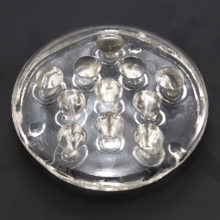
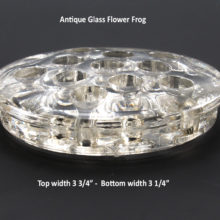
It is important the measurement of the flower frog match your intended use. This antique glass flower frog is rimmed so it can sit upon the rim of your flower bowl or vase, allowing the flower stems to be inserted through the open holes reaching down into the water. It can be placed in the base of a large bowl if you like. It was designed to float above the base of the vessel or sit inside a vessel. Has three little feet on the base to raise above surface when placed inside a flower vase or bowl.
Most agree these helpful flower arranging tools were called ‘flower frogs’ because they sit in water, like a frog. Flower frogs became widely popular in the US during the early 1900’s for use in flower arranging. The form and function was replaced In the mid 1950’s by a water-absorbent foam, stopping the development of glass flower frogs.
Glass flower frogs of yesteryear are a better choice than modern foam as they are re-usable, sturdy, collectible and beautiful in their own way. Click here to learn how to use flower frogs.
Retro Art Glass has a wide variety of flower frogs available, including more made with Uranium, click here to view the selection.
-
 $145.00
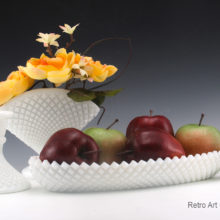
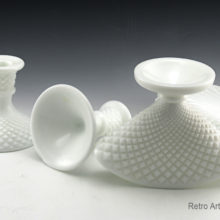
English Hobnail milk glass table or console centerpiece ensemble.
Made in the 1940’s – 1950’s by Westmoreland Glass, U.S.A. All items except the long bowl are marked by maker, WG embossed on the seats. Westmoreland Glass was an elegant glass maker of the early to mid 20th century, USA. They are no longer in business.
Thick, sturdy milk glass in English hobnail. Hobnails are flattened with four points. Normal hobnail pattern is rounded. The long bowl has a Sawtooth rim.
The vintage fan vase measures 5.25″ tall, 6.5″ wide and 1 5/8″ thick. It is in excellent condition. The long bowl measures 12″ long & 5″ wide. The long bowl has a sliver chip off one of the sharp Sawtooth points. See images. The candlestick holders are 5″ tall, one has a sliver chip on the base which can’t be seen, the other in excellent condition.
Well-made and sturdy opaque white glass goes with any color scheme. Beautiful and elegant decor focal point set.
-
 $195.00
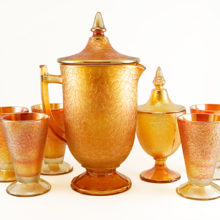
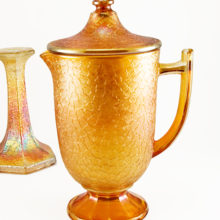
Depression glass beverage set of 9 made by Imperial Glass Co. or Jeannette Glass, circa 1930-1940.
Depression glass beverage set in Marigold Craquelle pattern. Set of 9 includes (1) 40 oz pitcher #119, (1) pitcher lid, (5) 6 oz #123 tumblers, and (1) comport, and (1) comport lid.
The faux crackle pattern is slightly raised on the exterior and smooth on the interior. Beautiful gold/orange iridescent Marigold color shimmers with glints of gold, yellow and orange.
Set is in amazingly good condition. The FIVE tumblers are in great condition with some wear showing on bases. Wear is light. No chips or cracks. One tumbler has minor rim chigger that cannot be seen, but can be felt.
Hand-made by mold. Handle was formed separately and then applied to the pitcher.
-
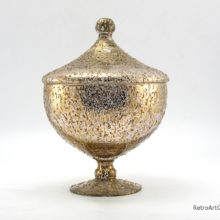 $65.00
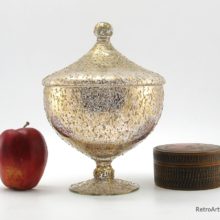
Large crystal circus tent jar with applied gold and white enamel spatter, called Golden Jewels by Maker West Virginia Glass Specialty Co.
Well-made high quality glass covered stemmed bowl. The spatter decor covers it from top to bottom and creates a raised texture on the surface.
Made in the 1960’s. The decor is 100% present, no wear. No damage to the glass. Images show a dark spot in the upper center, this is a reflection of the camera. The decor is uniform.
Big jar measures 9″ tall, 7″ at widest and weighs 1.4 lbs. Mold blown with hand-applied Golden Jewel decor.
Positively identified as West Virginia Glass Specialty Co. We’ve included an image of a label on an identical form with a variation on decor. This item does not have the label.
-
 $55.00
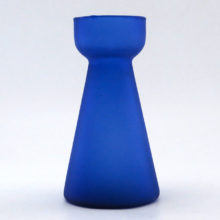
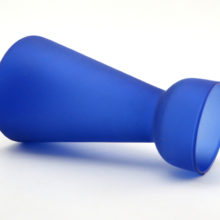
Vintage Hyacinth Vase in Monk Style
Monk style vintage Hyacinth vase, also called bulb vase, in beautiful satin blue. Place water inside and a flower or foliage bulb on top. Results in a beautiful indoor flower display.
Hyacinth vase forms often originate from Europe, but were made in all glass making countries. The monk style is particularly a European form.
Clear glass with deep satin cobalt exterior. The rims were heat polished. Blown into mold and hand-finished. In very good condition with some very light scratching to the cobalt satin acid finish.
Measures 8″ tall. Circa estimated 1940 – 1970. Could be earlier.
-
 $55.00
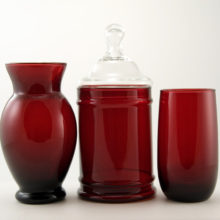
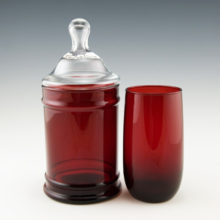
Vintage Blown Royal Ruby Glass Vanity Set Made in USA
In Anchor Hocking’s patented ruby glass color. Set includes: (1) covered canister just the right size for vanity items; (1) a vase for your posies; and (1) matching tumbler
Vintage Royal Ruby glass is unique, beautiful and functional. Deep jewel-like ruby color like this can’t be found on new made items. Perfect for the vanity, guest bathroom, kitchen or bar.
First developed in 1938, this wonderful ruby glass color survived through the 1970’s. Royal Ruby glass was produced in 100’s of shapes. Extra fun to collect.
All in excellent condition with medium bottom-wear. Circa 1940’s to 1970’s. Jar stands 8.5″ tall, 4″ round with a base girth of 12″. Water tumbler is 5″ tall. Vase is 6.5″ tall. All are blown from mold.
-
SOLD
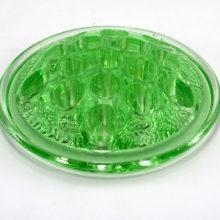
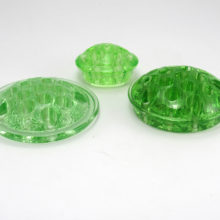
Large antique L.E. Smith Uranium glass flower frog was made in the 1920’s to 1930’s for assistance in flower arranging. The surface of the frog dome has little squiggly lines resembling hay. Made of Uranium glass which fluoresces bright glowing green under ultraviolet (black) light.The glass was created with Uranium to produce green colored glass at a time before Uranium was used for weapons. US production of Uranium glass ceased during World War II due to the US government’s confiscation of uranium supplies, and did not resume until 1958. After 1958, most Uranium glass objects were small figurines or reproductions of earlier antique forms. Read more about Uranium Glass.
This L.E. Smith Uranium glass flower frog was designed to sit upon the rim of your flower bowl or vase, allowing the flower stems to be inserted through the open holes reaching down into the water . It can be placed in the base of a bowl or vase if you’d like, as the rim will not prevent it, but it was specifically designed to float above the base of the vessel.
The L.E. Smith frog measures 4½” in diameter. The base is 4″ wide. Your flower vessel must have an 4″ wide opening for the frog to sit upon the rim. The frog has 16 holes. It is in perfect condition.
Most agree these helpful flower arranging tools were called ‘flower frogs’ because they sit in water, like a frog. Flower frogs became widely popular in the US during the early 1900’s for use in flower arranging. The form and function was replaced In the mid 1950’s by a water-absorbent foam, stopping the development of glass flower frogs.
Glass flower frogs of yesteryear are a better choice than modern foam as they are re-usable, sturdy, collectible and beautiful in their own way. Click here to learn how to use flower frogs.
Retro Art Glass has a wide variety of flower frogs available, including more made with Uranium, click here to view the selection.
-
 $45.00
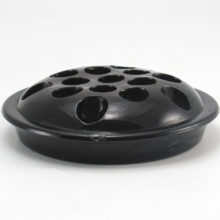
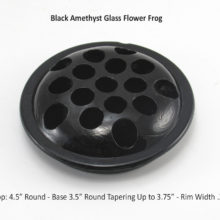
Large antique Black Amethyst glass flower frog was made in the 1920’s to 1930’s for assistance in flower arranging. It’s color is called Black Amethyst. It looks black, but is actually a very dark purple glass. In days gone by glass makers used dense purple or red glass to create black looking glass because they did not have a recipe for pure black glass.
This frog was designed to sit upon the rim of your flower bowl or vase, allowing the flower stems to be inserted through the open holes reaching down into the water . It can be placed in the base of a large bowl if you’d like, as the rim will not prevent it.
If you plan to use it as a rim balanced flower frog, your vessel opening rim must measure 3 ¼” to 4″ wide. The total width (diameter) of the round frog is 4½” wide. The frog rim is ¹⁄8″ inch wide. Stands 1¾” tall. The dome will rise above the level of the rim 1″. The flower stem holes are punched through (the punched through areas on the base reveal the true color, purple, when held to the light).
It weighs a tad over 1 lb. It is in great condition with one tiny sliver chip on the edge of the rim (view in image 1), no liquid stains.
Most agree these helpful flower arranging tools were called ‘flower frogs’ because they sit in water, like a frog. Flower frogs became widely popular in the US during the early 1900’s for use in flower arranging. The form and function was replaced In the mid 1950’s by a water-absorbent foam, stopping the development of glass flower frogs.
Glass flower frogs of yesteryear are a better choice than modern foam as they are re-usable, sturdy, collectible and beautiful in their own way. Click here to learn how to use flower frogs.
Retro Art Glass has a wide variety of flower frogs available, including more made with Uranium, click here to view the selection.
-
 $30.00
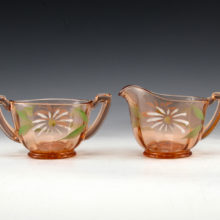
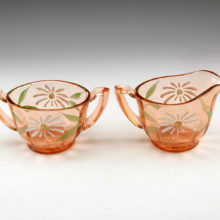
Pink Depression Glass Sugar & Creamer with Gay Fad Decor
Lovely pink Depression glass table service set for cream and sugar, or whatever else you’d like to put in them. Decorated with hand-painted flowers in a style referred to as Gay Fad back in the day. Gay meant cheery and happy back then.
They are both chip and crack free. The glass is in excellent condition. The hand-painted flowers are a bit faded, mostly on the leaves, but still bright and cheery.
The glass was formed from an optic mold created the vertical panels inside the glass. Probably made by Jeannette Glass Co. in the 1930’s to 1940’s.
Perfect for those sunny and gay mornings drinking coffee or tea!
-
SOLD
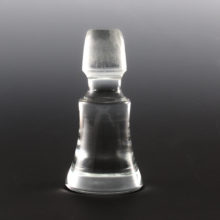
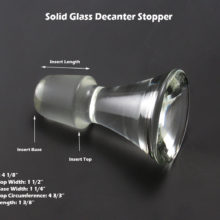
Glass bell decanter stopper made of solid glass. Colorless, will go well with any large decanter, jug or bottle.
Solid glass Bell decanter stopper measures 4¾” long. See image for exact measurements.
In excellent condition. Beautiful clarity. We have another bell stopper which is slightly smaller than this one.
To determine if this glass bell decanter stopper will fit your bottle:
Replacing missing stoppers is tricky. A good fit is essential. The measurements must match perfectly to the bottle neck opening in order to seal the air out and sit upright (without wiggling). Replaced stoppers are referred to as “married”, meaning the stopper is not original to the bottle.
- Measure the inner diameter of bottle neck opening. Use a soft tape measure to determine the width of the top opening. Measure the open space only, between the bottle neck opening. Do not include the glass rim of the bottle neck.
- The stopper’s ‘insert top’ (see image with measurements) should match the inner diameter (width) of the bottle neck opening exactly or just very slightly smaller. You can use your soft measuring tape to encircle the inner top opening to obtain the circumference.
- Most decanter bottle necks taper slightly down toward the vessel, resulting in a smaller neck measurement than the bottle neck opening. You should know the length of the insert. The insert is the portion of the stopper that enters the bottle neck opening.
- Take the measurement of the stopper’s insert length, from base to top of insert, and use your soft tape measure to determine where the stopper base will rest in your bottle neck. The stopper’s ‘insert base’ should measure exactly or just very slightly smaller than the measurement of the area of the bottle neck where it will rest when inserted.
Most stoppers made for the decanters from the past have a ground area encircling the stopper base. These stoppers have been ‘ground to fit’ by the maker for the exact bottle they were made for. If you know how to grind glass, or know someone who does, you can have your stopper altered to fit your bottle. This can be done only with stopper inserts that are slightly larger than the bottle neck.
Trying to get a perfect ‘marriage’ between a vintage glass decanter and replacement stopper is not easy. Often, even when the measurements match up, the stopper will tend to lean or wiggle. If your decanter is for decor purposes only, and you do not plan on using it as a decanter, you can put a small blob of putty or wax on the inner neck of the bottle to stabilize the stopper.
Click here to view all the marriageable stoppers available at Retro Art Glass.
-
SOLD
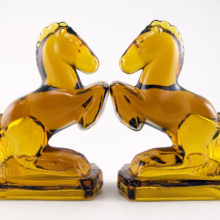
Beautiful vintage amber glass horse bookends by LE Smith.
Vintage glass horse bookends in lovely amber. The thick caramel colored glass changes in intensity according to the varying thickness of the glass and the lighting conditions, much like the real amber gem.
Heavy glass bookends. Each weigh just over 3 lbs. Measure 8″ tall, 5″ long and 3″ wide. Shown with large books in images.
Made by mold in the 1940’s by L.E. Smith and Fostoria, both major glass makers of the time.
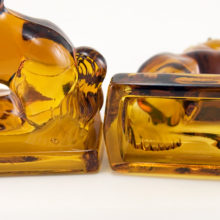
See image 2; there are two trapped air bubbles within the glass on the bases. This is expected with hand-made Depression era glass.
-
 $45.00
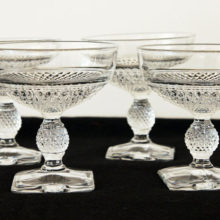
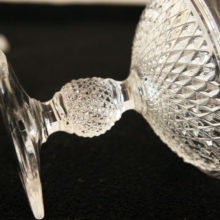
Set of Elegant Depression Glass Mount Vernon Stemware Cocktail or Dessert
Quality Cambridge Glass Mount Vernon stemware set of four. Circa 1930’s. This fine old glass was made with a 4-part mold. Cambridge produced the Mount Vernon pattern from 1931 to 1957. These beauties are of early production. They glow yellow under black-light, indicating the presence of manganese which will turn purple if left in high light or sun light for long periods of time.
Elegant Mount Vernon stemware depression glass, used in the finer homes for everyday dishes. Sparkling clear, thick well-made glass. The rims were hand finished and fire polished to produce silky smoothness. Cambridge had a quality of glass that was almost velvety to the touch.
All in excellent condition. Cambridge part no. 42, holds 5.5 oz, stands 4″ tall.
-
 $50.00
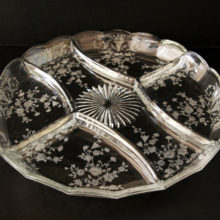
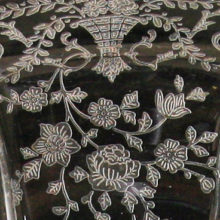
Cambridge Portia Five Part Elegant Depression Glass Server
Colorless etched elegant Depression glass made by Cambridge Glass, USA, circa 1932-1953. High quality heat finished table glass.
Manganese was used in place of lead (scarce during Depression years) to add strength to the glass. If clear glass glows yellow under black light, it probably dates from the early 20th century to the 1950’s. Glass with manganese will turn light purple if over-exposed to bright light for a long period of time. Cambridge used manganese until the 1950’s. They were one of the last glass makers to use it.
Cambridge made the beautiful Portia etched line from 1932 to 1953. Big, fancy 5-part round celery / relish dish. Cambridge part no 394. Measures 10.5″ wide. Substantial glass weighs 2.5 lbs. In Excellent condition with some bottom-wear. Glass is colorless, no hint of purple.
-
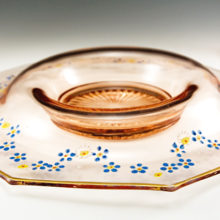 $135.00
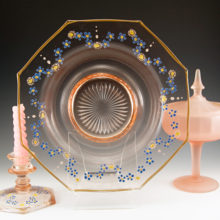
Pink Depression Glass console set with floral and sun enamel decor. Set includes (1) octagon rolled bowl, and (2) matching candlestick holders.
Elegant pink Depression glass probably made by Jeannette Glass Circa 1930’s to 1950’s. Other major Elegant Depression Glass makers of the era like Fostoria, Imperial or US had very similar patterns with octagon shapes.
In very good condition. No chips or cracks, glass is clean and brilliant, and the enamel is still whole and bright. All three pieces have real gold trim. The trim is 90% present on the console bowl, only slight rubbing on corners and edges. The gold trim on both candlestick holders has nearly disappeared, remnants of gold visible if you look closely. The age rubs on the soft, real gold trimmings are consistent with its age and occasional use.
This beautiful set was meant to grace the dining table or console table. Shown with a Jeannette Glass pink satin comport, not included. Set includes two candlestick holders; 3½” tall and 5″ wide; and one large 12″ eight-sided rolled bowl. Bowls like this were made to hold snacks or flower frogs, although not shown in the images below, a clear glass frog will be included.