Showing 31–60 of 116 resultsSorted by latest
-
 $195.00
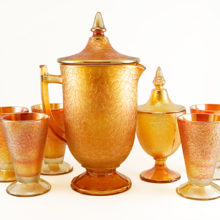
Depression glass beverage set of 9 made by Imperial Glass Co. or Jeannette Glass, circa 1930-1940.
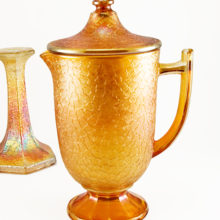
Depression glass beverage set in Marigold Craquelle pattern. Set of 9 includes (1) 40 oz pitcher #119, (1) pitcher lid, (5) 6 oz #123 tumblers, and (1) comport, and (1) comport lid.
The faux crackle pattern is slightly raised on the exterior and smooth on the interior. Beautiful gold/orange iridescent Marigold color shimmers with glints of gold, yellow and orange.
Set is in amazingly good condition. The FIVE tumblers are in great condition with some wear showing on bases. Wear is light. No chips or cracks. One tumbler has minor rim chigger that cannot be seen, but can be felt.
Hand-made by mold. Handle was formed separately and then applied to the pitcher.
-
 $65.00
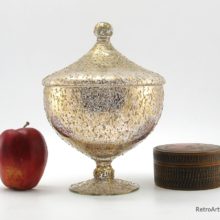
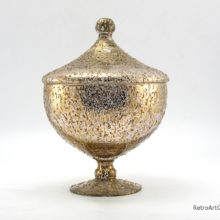
Large crystal circus tent jar with applied gold and white enamel spatter, called Golden Jewels by Maker West Virginia Glass Specialty Co.
Well-made high quality glass covered stemmed bowl. The spatter decor covers it from top to bottom and creates a raised texture on the surface.
Made in the 1960’s. The decor is 100% present, no wear. No damage to the glass. Images show a dark spot in the upper center, this is a reflection of the camera. The decor is uniform.
Big jar measures 9″ tall, 7″ at widest and weighs 1.4 lbs. Mold blown with hand-applied Golden Jewel decor.
Positively identified as West Virginia Glass Specialty Co. We’ve included an image of a label on an identical form with a variation on decor. This item does not have the label.
-
 $150.00
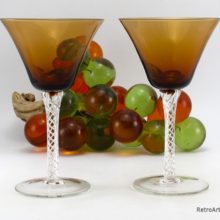
Set of Blenko Art Glass air twist goblets Line 500. Shown in Blenko’s 1956 catalog.
Very hard to find survivors of Blenko’s early years. Designed by Bill Blenko himself. Big and Beautiful hand-blown air twist stem goblets.
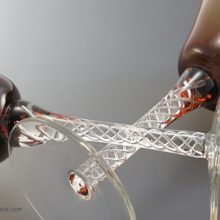
Set of two measure approx. 8½” tall. Flared bowl measures 4½” wide at top. One is in excellent condition, one has a small, thin sliver chip on the rim. See image 4.
Lovely dark amber bowl applied to the air twist stem. Circa late 1950’s.
-
 $95.00
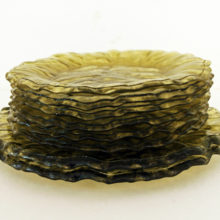
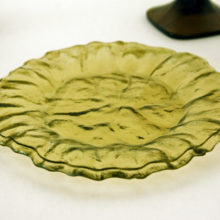
Morgantown El Mexicano Vintage Glass Plates Set of Eight – Scarce
Vintage glass plates by Morgantown are in a scarce pattern which has evolved since the early 1930’s, originally called El Mexicano. The pattern variation name ‘Crinkle’ was produced in 1962 through the 1970’s. Very hard to find today.
The pattern was originally designed to look like the primitive plates found at an Inca archaeology dig. According to Morgantown Glass, the Spaniards taught the Incas the secrets of glass, but they had only crude materials and tools which produced “rough hewn glass objects”. Advertised as “An Ancient Technique Revived!” Called by numerous names, Del Rey, El Mexicano, Ockner, El Rancho and Crinkle glass.
The vintage glass plates are made of heavy double layered glass. The two layers are sandwiched together, the seam can be seen nears the rims. Color is moss green, a yellowish green. Very heavy glass.
Set includes (2) 8″ plates and (6) 6.5″ plates. Heavy glass, 8.5 lbs total plate weight. Would make the perfect dessert set for country, mid-century gothic, primitive, ocean, or organic decor. In near mint condition.
There are no chips, no cracks, no hazing. The rough edged rims have a minute amount of chiggers, that can’t be seen at all.
-
 $260.00
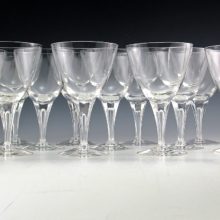
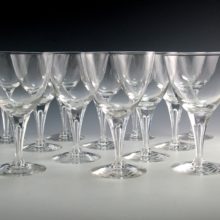
Set of 12 vintage Tiffin crystal goblets with elongated bubble stems from the 1970’s.
Ready to grace the table at your elegant dinner party. These high quality vintage crystal wine glasses produce lingering tones when plinked. Stylized air-bubble trapped within the 5-panel stem.
Produced in the 1970’s by Tiffin Glass, an upscale elegant glass maker from Ohio, USA. Cataloged Tiffin stem #17596.
Eleven of the twelve are in excellent condition. One has a shallow smooth rim chip on the upper bowl. Use the goblet with the rim chip as the ‘hostess glass’. Large goblets measure 6½” tall, 4″ wide bowl.
Incredibly hard to find this quality made vintage crystal stemware, especially as a set of 12.
-
 $165.00
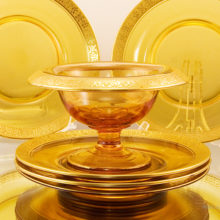
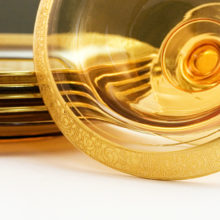
Very special gold encrusted antique dessert service set by Tiffin Glass. Circa 1920’s-1930’s.
Antique dessert service set of 6. All are hand decorated with real gold in the Rambler Rose pattern. The plates have polished seat rims. The blown compote has a pontil mark and applied stem.
Set includes (5) 7″ dessert plates and (1) dessert sauce compote. One of the dessert plates can serve as a liner for the compote. Aperitif goblet shown in images is not included.
Incredible find, such a beautiful nearly untouched set. The amber color of the glass is unusual as the Rambler Rose gold encrusted decor is usually found on clear glass. The amber color multiplies the elegance of this set. In excellent condition – the gold is thick and 98% present.
-
 $65.00
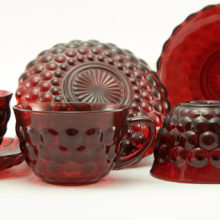
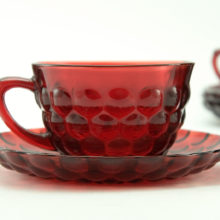
Vintage Royal Ruby Bubble coffee service set for four.
Set of Royal Ruby Bubble cups and saucers. Includes four saucers and four cups.
Beautiful patented Royal Ruby color by Anchor Hocking, USA circa 1940’s to 1960’s. This popular pattern was called Bubble. The first Anchor Hocking catalog featuring this pattern in 1941 called it Bullseye. The Bubble pattern came in Royal Ruby, colorless, Forest Green, Sapphire Blue, Opaque White, and Iridescent.
It’s great fun to collect the Bubble pattern. A large number of table glass and decorative forms were produced. The Royal Ruby color is most highly sought by collectors. Royal Ruby table glass, vases, etc. are favorites for adorning the holiday table.
Anchor Hocking made glass to endure heavy use. It’s hard to find this glass without some signs of usage because it is all at least 50 years old now. There are two sets available (choose quantity above) and all are in pristine condition.
-
 $55.00
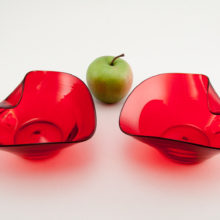
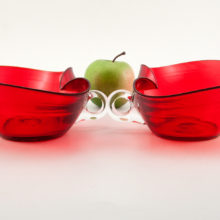
Vintage Art Glass Ruby Bowls by Pilgrim Art Glass
Pair of vintage art glass ruby bowls by Pilgrim Art Glass hand-made in mid-20th century U.S.A.
Shown in 1960’s Pilgrim Art Glass catalogs as style no. 437269. Part of Pilgrim Art Glass’ Epic line.
Designed by the infamous Moretti brothers who studied on the Isle of Murano in Italy. Made in Murano style, formed by hand with applied handles. Pontil scars on the base.
These beautiful ruby bowls with colorless applied handles have multiple uses. Perfect on the dining table for gravy and sauces. Also make nice snack servers, flower holders or catch-all’s. Beautiful as hostess gifts filled with goodies.
Measure 7.5″ long, 6.5″ wide and 2.75″ tall. Offered as a set of two. Both in perfect condition.
-
 $110.00
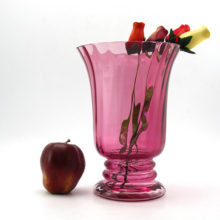
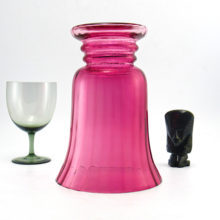
Lovely large vintage cranberry glass flared vase with original Pilgrim Art Glass label.
Perfect size for a dozen big roses (image 1 has small wooden roses shown). Measures 9″ tall with a 6¼” wide flared opening. Weighs 2½ pounds.
Pilgrim is famous for their cranberry glass creations. This is an unusual form, rarely seen. Estimated circa 1960’s to 1970’s.
Pulled from a multi-optic panel mold, then mouth blown to size and hand-finished to create the form. The rim is shaved and polished. Distinctive triple hoop base. The pontil scar was erased when the rim was shaved.
This large vintage cranberry glass vase is clean as a whistle, rarely used if at all. Label still attached. There is one extremely tiny flea bite on the rim. Cannot be seen but can be felt when running a finger over the rim.
Cranberry glass achieves its color from the addition of real gold to the glass batch. The amount of gold used determines the shade of pink. This big beauty is in a medium dark shade.
Give your love a dozen roses in a stunning hand-made vintage cranberry glass vase by the infamous Pilgrim Art Glass! He or she will swoon and love you forever.
-
 $130.00
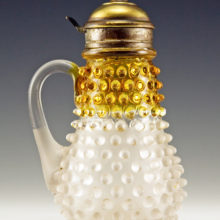
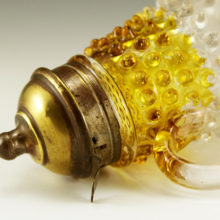
Hobbs Brockunier Frances Ware Antique Syrup Pitcher
Antique syrup pitcher from the Frances Ware line by Hobbs Brockunier. Turn of the century American art glass, circa late 1800’s. ‘Francis Ware’ was named after Grover Cleveland’s (USA President) wife Frances Folsom.
Beautiful Early American Pattern Glass (EAPG) hobnail pattern with a satin frost acid treatment on the lower half and a bright glowing amber on the upper portion. Hobbs Brockunier made quite a few table items in this pattern. Hard to find, but a real pleasure to collect.
Many Frances Ware items found today have chipped hobnails from bumping into other table items over the last 100+ years. This old stunner has only 1 small chigger on one hobnail on the body of the pitcher. On the base, the seat of the pitcher, there are approximately 8 chiggers off the last two rings of hobnails. These chiggers are invisible unless the pitcher is turned upside-down. They were caused by surface wear. See image 4.
The antique syrup pitcher has a pewter lid with 2 visible dents on the finial. The lid is intact and secure. Thumb tab flips up the lid to reveal a pouring spout. The lid seems to have a spring type control that provides tension while opening and it insures the lid shuts when the thumb pressure is removed. Whatever hardware used for this upgrade function is hidden within the thick walls of the cap.
The glass is sparkling clean with no residue stains. The solid glass handle was applied to the body. Made by hand over 100 years ago. Measures 7″ tall, 4½” at widest.
Shown in The Collector’s Encyclopedia of American Art Glass on page 74.
-
 $160.00
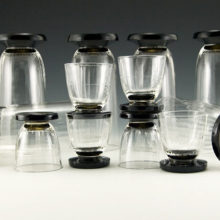
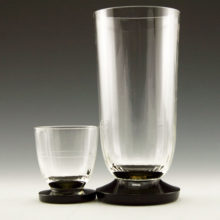
Morgantown Crystal 32 Panel Blown Crystal Bar Tumbler Set of 12
Vintage blown crystal bar tumbler set by Morgantown Glass USA. Made in the early 1950’s. Morgantown Glass part no. 715. Set of 12 includes (6) 15 oz. highball tumblers and (6) 1½ oz. cordial shot glasses
Hand-blown crystal from a 32 panel optic mold. The plethora of optic panels produce a beautiful shimmer that’s hard to capture in images. It is very unusual to have so many panels.
Made of quality crystal. Rims are heat finished. Dark olive green solid glass foot was hand-made and applied to to the bowl. Pontil marks at the base of the foot. The highballs measure 6.25″ tall, the shot glasses are 2.5″ tall.
Strong crystal ring tone. No damage, like new. Incredibly beautiful glassware for the table or bar. Made in the U.S.A. Rare find, especially as a set.
-
 $140.00
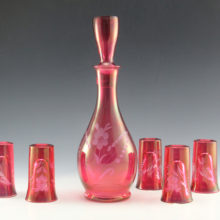
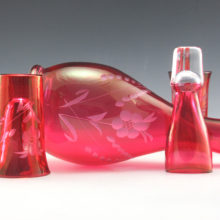
Art Deco glass decanter with jigger stopper and 5 shots made in the 1920’s to 1930’s. Flashed in luminous cranberry and etched in Cornflower.
Beautiful set of Art Deco glass decanter cocktail hour accessories. Full size blown glass decanter with a stopper that serves as a shot glass. Included are five standard shot glasses in the same pattern from the same maker.
The glass was hand-formed, then flashed with a deep cranberry, almost ruby, luminous color. The Cornflower decor was wheel cut through the colored flashing revealing the colorless glass beneath.
Cornflower decor was offered by many glass-makers, but the design varied. Cambridge and Fostoria glass are well known for their Cornflower etchings, but the decor here does not match their styles. The key is the two leaves protruding from the top of the Cornflowers.
The decanter measures 9½” tall. The set is in very good condition considering its age and flashed color. There is slight flashing wear on the tips of the rims on the shot glasses. There are no chips or scratches.
-
 $55.00
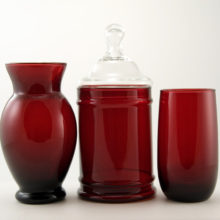
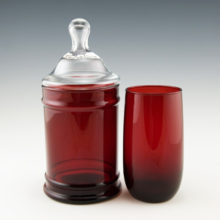
Vintage Blown Royal Ruby Glass Vanity Set Made in USA
In Anchor Hocking’s patented ruby glass color. Set includes: (1) covered canister just the right size for vanity items; (1) a vase for your posies; and (1) matching tumbler
Vintage Royal Ruby glass is unique, beautiful and functional. Deep jewel-like ruby color like this can’t be found on new made items. Perfect for the vanity, guest bathroom, kitchen or bar.
First developed in 1938, this wonderful ruby glass color survived through the 1970’s. Royal Ruby glass was produced in 100’s of shapes. Extra fun to collect.
All in excellent condition with medium bottom-wear. Circa 1940’s to 1970’s. Jar stands 8.5″ tall, 4″ round with a base girth of 12″. Water tumbler is 5″ tall. Vase is 6.5″ tall. All are blown from mold.
-
 $210.00
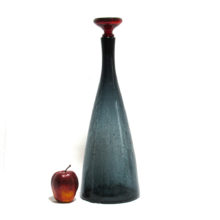
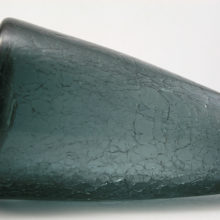
Big Blenko Art Glass Decanter Charcoal Crackle
This Blenko Art Glass decanter bottle was made in the rare Charcoal color. Item’s in Blenko’s Charcoal color are relatively hard to find. The color was produced only a few years; 1954 to 1958, 1961 to 1962, and 1971.
The giant form was designed by Winslow Anderson, an infamous mid-century glass artist who worked with Blenko from 1947 to 1953. It is a 920L decanter and originally came with a tall teardrop stopper in matching color. This decanter has lost its original stopper. The stoppers are very easy to break and usually don’t survive the years.
The bottle is shown with a ‘married’ ruby glass hand-blown stopper from the same era. The stopper fits well, in itself is hard to find, and looks awesome until a matching charcoal flame stopper is found.
The bottle was mouth-blown, hand-formed, then sheared at the neck opening. It was dipped in ice water while still hot to create the crackle effect. The neck opening rim was fire-polished smooth.
The base still retains Blenko’s inventory label. It reads: “Blenko, Milton W.VA 0920L”. The bottle stands a whopping 16.5″ tall and weighs 3.6 lbs. The neck opening is 1 1/8″ wide (measured from inner wall). In perfect condition. Glass is clean and brilliant.
-
 $40.00
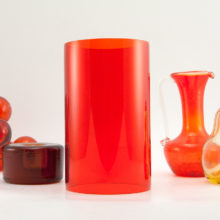
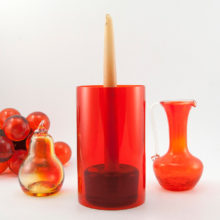
Retro modern glass candle tube chimney in hand-blown Tangerine
Tangerine retro glass candle chimney made in the 1960’s – 1970’s. Mod hot orange color called Tangerine by most mid-century modern glass makers.
Made to fit over puck style candlestick holders. Reflects a beautiful soft dark orange light with lit candle inside. Shown with a Blenko Chestnut puck candle holder (available separately).
In like-new condition. Contains an elongated bubble within the glass left by the hand-blowing process. Measures 6.75″ tall, 4″ wide, circumference 12.75″.
-
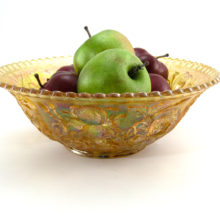 $40.00
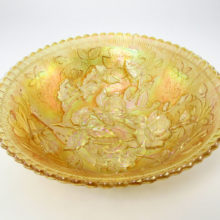
Imperial Glass Open Rose Rubigold Lustre 10″ Bowl Vintage
This large Imperial Glass Open Rose Rubigold bowl measures 10″ round, 3¾” tall and weighs 2.2 lbs. Made of quality, thick vintage glass. The pattern ‘Open Rose’ is deep and detailed. Sometimes you’ll find dulled, almost blurred patterns on antique or vintage pattern glass due to an aging, overused mold. This bowl’s pattern is sharp and clear. It is in excellent condition.
Imperial Glass began making Carnival Glass around 1908. In 1962 Imperial made the first reissues of their Carnival pattern glass. Most, but not all, items from this period were marked with the well known IG. The color ‘Rubigold’ was produced only between 1965 and 1972. This bowl was not marked with the IG on the base.
Beautiful color with shy hints of Ruby highlights within the iridescent gold carnival glass. Lovely bowl for your table or as a hostess gift filled with goodies.
-
 $110.00
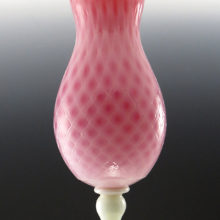
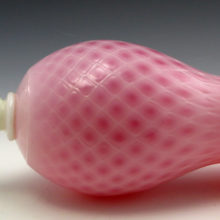
Tall Diamond Quilted Glass Vase with Alabaster Foot
Elegant, eye-catching diamond quilted glass vase with applied two-part alabaster glass foot. Vase measures 11″ tall. Big, beautiful vase can hold a large bunch of flowers.
Made by blowing two layers of glass into a diamond pattern mold. The creamy white glass (called alabaster) used on the stem and foot was hand-made in two parts and applied to the vase. The inner layer is a very dark salmon color. The 4″ wide vase opening was ruffled with blow-torch and hand tool.
Probably created in Italy for export to the U.S., but it could be early 20th Century American made. The diamond quilted cut velvet decor was popular in the Victorian era. The decor style regained popularity in the 1940’s to 1950’s.
The applied two part stem and foot point to a quality maker. Victorian era glass often sported this style of foot. During the Mid-20th Century, major Italian glass houses exported vases like this to decor distributors in the U.S. Estimated circa: 1920 to 1960.
This vase is in excellent condition.
-
 $60.00
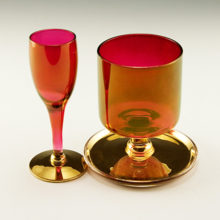
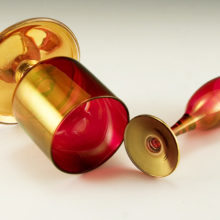
Antique elegant ruby blown glass with a golden glow.
Have a smoke and a little spirit in elegant style! Beautiful ruby blown glass goblet and cigarette or paraphernalia holder. Rich golden ruby color achieved using real gold from yesteryear.
In great + condition. It’s rare to find antique glass in this decor style without wear. This set is almost perfect with a few tiny pinholes and scratches of wear on the gold surface that cannot be seen unless held up to the light. The gold appears perfect under normal conditions. The flashed gold ruby is in excellent condition, bright and with a glowing gold reflection. No chips or cracks.
The cigarette holder style was made by elegant glass makers of the early 1900’s to the 1940’s. Looks like it may be by Cambridge Glass, an elegant maker of the era. This set is at least 70 years old.
The holder is 3.5″ tall with a 3.5″ base. Its turned up base was meant to be an ashtray, but don’t use it as one. The decor is delicate and will not hold up to grinding hot ashes into it. It could be used as a matchstick or other paraphernalia holder. The liquor glass stem is 4.25″ tall.
Both items are hand-blown with pontil marks. The bases are applied to the vessels. -
 $20.00
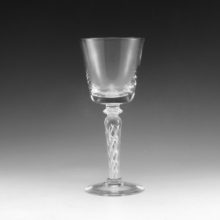
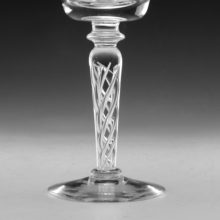
Vintage air twist stem wine glass. Maker unknown. Steuben glass is best known for their air twist stemware and other bar ware.
Beautifully done air twist, see stem image closeup. The glass artist inserted the air bubbles into the glass, then elongated and twisted the bubbles.
Stands 5″ tall. Stem was applied to foot and bowl. In perfect condition.
-
 Items in the Retro Art Glass Museum are not for sale. Read more about this item below. To view Retro Art Glass items for sale click here…
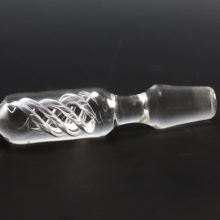
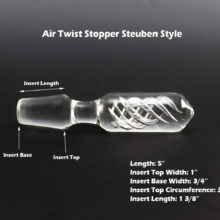
Beautiful air twist stopper in fine crystal. Steuben is famous for their air-twist crystal glassware. Not sure if this is Steuben as it has a slightly pointed head and the Steuben air twists for their large decanters have a flat head. Its superior crystal quality and precise air twist point to a very fine maker.
Click here to read more about Steuben Glass Works.
Measures 5″ long. See image for additional measurements for determining if this air twist stopper will fit your decanter, bottle or jug.
In excellent condition. Outstanding clarity. The streaks in the images are reflections from the lighting mingling with the air twist.
To determine if your stopper will fit your bottle:
Replacing missing stoppers is tricky. A good fit is essential. The measurements must match perfectly to the bottle neck opening in order to seal the air out and sit upright (without wiggling). Replaced stoppers are referred to as “married”, meaning the stopper is not original to the bottle.
- Measure the inner diameter of bottle neck opening. Use a soft tape measure to determine the width of the top opening. Measure the open space only, between the bottle neck opening. Do not include the glass rim of the bottle neck.
- The stopper’s ‘insert top’ (see image with measurements) should match the inner diameter (width) of the bottle neck opening exactly or just very slightly smaller. You can use your soft measuring tape to encircle the inner top opening to obtain the circumference.
- Most decanter bottle necks taper slightly down toward the vessel, resulting in a smaller neck measurement than the bottle neck opening. You should know the length of the insert. The insert is the portion of the stopper that enters the bottle neck opening.
- Take the measurement of the stopper’s insert length, from base to top of insert, and use your soft tape measure to determine where the stopper base will rest in your bottle neck. The stopper’s ‘insert base’ should measure exactly or just very slightly smaller than the measurement of the area of the bottle neck where it will rest when inserted.
Most stoppers made for the decanters from the past have a ground area encircling the stopper base. These stoppers have been ‘ground to fit’ by the maker for the exact bottle they were made for. If you know how to grind glass, or know someone who does, you can have your stopper altered to fit your bottle. This can be done only with stopper inserts that are slightly larger than the bottle neck.
Trying to get a perfect ‘marriage’ between a vintage glass decanter and replacement stopper is not easy. Often, even when the measurements match up, the stopper will tend to lean or wiggle. If your decanter is for decor purposes only, and you do not plan on using it as a decanter, you can put a small blob of putty or wax on the inner neck of the bottle to stabilize the stopper.
Click here to view all the marriageable stoppers available at Retro Art Glass.
-
SOLD
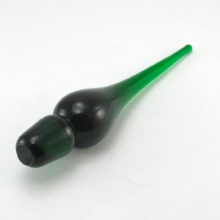
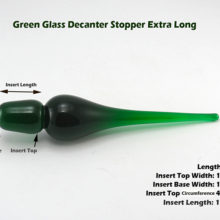
Retro decanter stopper teardrop in green glass with internal bubble.
Hand-blown retro decanter stopper in green glass measures 10″ long. Solid glass. Made in the U.S.A. during the Mid-Century Modern decor period (1940’s to 1970’s).
It is in perfect condition. Please see the image provided of this green teardrop retro decanter stopper for exact measurements.
These big stoppers were made for the fabulously large decanters so popular back in the day they were produced, and still so very popular today but hard to find. Often we find the big decanter bottles without the stoppers because the stoppers are prone to break.
To determine if your stopper will fit your bottle:
Replacing missing stoppers is tricky. A good fit is essential. The measurements must match perfectly to the bottle neck opening in order to seal the air out and sit upright (without wiggling). Replaced stoppers are referred to as “married”, meaning the stopper is not original to the bottle.
- Measure the inner diameter of bottle neck opening. Use a soft tape measure to determine the width of the top opening. Measure the open space only, between the bottle neck opening. Do not include the glass rim of the bottle neck.
- The stopper’s ‘insert top’ (see image with measurements) should match the inner diameter (width) of the bottle neck opening exactly or just very slightly smaller. You can use your soft measuring tape to encircle the inner top opening to obtain the circumference.
- Most decanter bottle necks taper slightly down toward the vessel, resulting in a smaller neck measurement than the bottle neck opening. You should know the length of the insert. The insert is the portion of the stopper that enters the bottle neck opening.
- Take the measurement of the stopper’s insert length, from base to top of insert, and use your soft tape measure to determine where the stopper base will rest in your bottle neck. The stopper’s ‘insert base’ should measure exactly or just very slightly smaller than the measurement of the area of the bottle neck where it will rest when inserted.
Most stoppers made for the large decanters from the past have a ground area encircling the stopper base. These stoppers have been ‘ground to fit’ by the maker for the exact bottle they were made for. If you know how to grind glass, or know someone who does, you can have your stopper altered to fit your bottle. This can be done only with stopper inserts that are slightly larger than the bottle neck.
Trying to get a perfect ‘marriage’ between a vintage glass decanter and replacement stopper is not easy. Often, even when the measurements match up, the stopper will tend to lean or wiggle. If your decanter is for decor purposes only, and you do not plan on using it as a decanter, you can put a small blob of putty or wax on the inner neck of the bottle to stabilize the stopper.
Click here to view all the marriageable stoppers available at Retro Art Glass.
-
SOLD
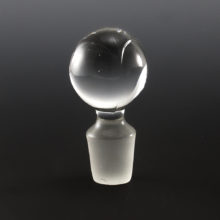
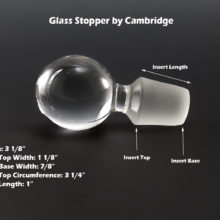
Cambridge glass stopper for #3400/92, 32 ounce ball decanter.
This Cambridge glass stopper fits their 1940’s ball decanter, but it can fit other decanters too. See image for exact measurements.
The pressed glass stopper has a square impression on the top, hard to see in the images. It is in excellent condition.
To determine if your stopper will fit your bottle:
Replacing missing stoppers is tricky. A good fit is essential. The measurements must match perfectly to the bottle neck opening in order to seal the air out and sit upright (without wiggling). Replaced stoppers are referred to as “married”, meaning the stopper is not original to the bottle.
- Measure the inner diameter of bottle neck opening. Use a soft tape measure to determine the width of the top opening. Measure the open space only, between the bottle neck opening. Do not include the glass rim of the bottle neck.
- The stopper’s ‘insert top’ (see image with measurements) should match the inner diameter (width) of the bottle neck opening exactly or just very slightly smaller. You can use your soft measuring tape to encircle the inner top opening to obtain the circumference.
- Most decanter bottle necks taper slightly down toward the vessel, resulting in a smaller neck measurement than the bottle neck opening. You should know the length of the insert. The insert is the portion of the stopper that enters the bottle neck opening.
- Take the measurement of the stopper’s insert length, from base to top of insert, and use your soft tape measure to determine where the stopper base will rest in your bottle neck. The stopper’s ‘insert base’ should measure exactly or just very slightly smaller than the measurement of the area of the bottle neck where it will rest when inserted.
Most stoppers made for the decanters from the past have a ground area encircling the stopper base. These stoppers have been ‘ground to fit’ by the maker for the exact bottle they were made for. If you know how to grind glass, or know someone who does, you can have your stopper altered to fit your bottle. This can be done only with stopper inserts that are slightly larger than the bottle neck.
Trying to get a perfect ‘marriage’ between a vintage glass decanter and replacement stopper is not easy. Often, even when the measurements match up, the stopper will tend to lean or wiggle. If your decanter is for decor purposes only, and you do not plan on using it as a decanter, you can put a small blob of putty or wax on the inner neck of the bottle to stabilize the stopper.
Click here to view all the marriageable stoppers available at Retro Art Glass.
-
 $45.00
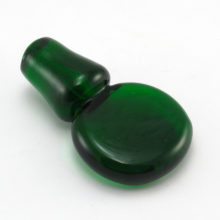
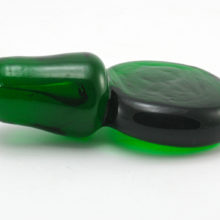
Big vintage emerald green glass stopper for decanters with disc topper.
Hand-made solid emerald green glass stopper measures 5″ long. Made in the U.S.A. during the Mid-Century Modern decor period (1940’s to 1970’s). Solid glass.
Please see image provided of the emerald green disc stopper for exact measurements. Probably made in Italy or by Blenko Art Glass. It is in perfect condition.
This big mid-century modern vintage decanter stopper in emerald green was made for the fabulously large decanters so popular back in the day they were produced, and still so very popular today but hard to find. Often we find the big decanter bottles without the stoppers because the stoppers are prone to break.
To determine if your stopper will fit your bottle:
Replacing missing stoppers is tricky. A good fit is essential. The measurements must match perfectly to the bottle neck opening in order to seal the air out and sit upright (without wiggling). Replaced stoppers are referred to as “married”, meaning the stopper is not original to the bottle.
- Measure the inner diameter of bottle neck opening. Use a soft tape measure to determine the width of the top opening. Measure the open space only, between the bottle neck opening. Do not include the glass rim of the bottle neck.
- The stopper’s ‘insert top’ (see image with measurements) should match the inner diameter (width) of the bottle neck opening exactly or just very slightly smaller. You can use your soft measuring tape to encircle the inner top opening to obtain the circumference.
- Most decanter bottle necks taper slightly down toward the vessel, resulting in a smaller neck measurement than the bottle neck opening. You should know the length of the insert. The insert is the portion of the stopper that enters the bottle neck opening.
- Take the measurement of the stopper’s insert length, from base to top of insert, and use your soft tape measure to determine where the stopper base will rest in your bottle neck. The stopper’s ‘insert base’ should measure exactly or just very slightly smaller than the measurement of the area of the bottle neck where it will rest when inserted.
Most stoppers made for the large decanters from the past have a ground area encircling the stopper base. These stoppers have been ‘ground to fit’ by the maker for the exact bottle they were made for. If you know how to grind glass, or know someone who does, you can have your stopper altered to fit your bottle. This can be done only with stopper inserts that are slightly larger than the bottle neck.
Trying to get a perfect ‘marriage’ between a vintage glass decanter and replacement stopper is not easy. Often, even when the measurements match up, the stopper will tend to lean or wiggle. If your decanter is for decor purposes only, and you do not plan on using it as a decanter, you can put a small blob of putty or wax on the inner neck of the bottle to stabilize the stopper.
Click here to view all the marriageable stoppers available at Retro Art Glass.
-
 $65.00
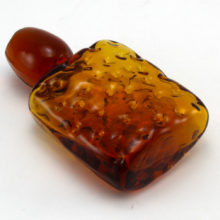
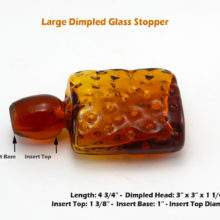
Big hand-blown decanter stopper in glowing amber with dimples
Hand-blown decanter stopper measures 4″ long. Made in the U.S.A. during the Mid-Century Modern decor period (1940’s to 1970’s). Probably made by Blenko Art Glass.
It is in perfect condition. Please see image of the dimpled amber glass stopper for exact measurements.
These big stoppers were made for the fabulously large decanters so popular back in the day they were produced, and still so very popular today but hard to find. Often we find the big decanter bottles without the stoppers because the stoppers are prone to break.
Replacing missing stoppers is tricky. A good fit is essential. The measurements must match perfectly to the bottle neck opening in order to seal out the air and sit upright (without wiggling). Replaced stoppers are referred to as “married”, meaning the stopper is not original to the bottle.
To determine if your stopper will fit your bottle:
- Measure the inner diameter of bottle neck opening. Use a soft tape measure to determine the width of the opening. Measure the open space only between the bottle neck opening. Do not include the glass rim of the bottle neck.
- The stopper’s ‘insert top’ (see image with measurements) should match the inner diameter of the bottle neck opening exactly or just very slightly smaller. You can determine the circumference measurement by wrapping a soft measuring tape around the inner top of the bottle neck.
- Most decanter bottle necks taper slightly down toward the vessel, resulting in a smaller neck measurement than the bottle neck opening. You should know the length of the insert. The insert is the portion of the stopper that enters the bottle neck opening.
- Take the measurement of the stopper’s insert from base to top of insert, and use your soft tape measure to determine where the stopper base will rest in your bottle neck. The stopper’s ‘insert base’ should measure exactly or just very slightly smaller than the measurement of the area of the bottle neck where it will rest when inserted.
Most stoppers made for the large decanters from the past have a ground area encircling the stopper base. These stoppers have been ‘ground to fit’ by the maker for the exact bottle they were made for. If you know how to grind glass, or know someone who does, you can have your stopper altered to fit your bottle. This can be done only with stopper inserts that are slightly larger than the bottle neck.
Trying to get a perfect ‘marriage’ between a vintage glass decanter and replacement stopper is not easy. Often, even when the measurements match up, the stopper will tend to lean or wiggle. If your decanter is for decor purposes only, and you do not plan on using it as a decanter, you can put a small blob of putty or wax on the inner neck of the bottle to stabilize the stopper.
Click here to view all the marriageable stoppers available at Retro Art Glass.
-
SOLD
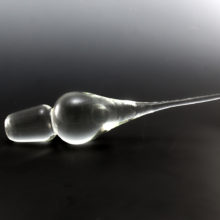
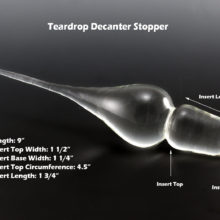
Large crystal stopper for mid-20th century decanter. Measures 9″ long. Teardrop form. Hand-made of solid glass.
Colorless stoppers look great with colored glass bottles. This large crystal stopper is in excellent condition.
Use the measurements provided in image to determine if this large crystal stopper will fit your bottle.
To determine if your stopper will fit your bottle:
Replacing missing stoppers is tricky. A good fit is essential. The measurements must match perfectly to the bottle neck opening in order to seal the air out and sit upright (without wiggling). Replaced stoppers are referred to as “married”, meaning the stopper is not original to the bottle.
- Measure the inner diameter of bottle neck opening. Use a soft tape measure to determine the width of the top opening. Measure the open space only, between the bottle neck opening. Do not include the glass rim of the bottle neck.
- The stopper’s ‘insert top’ (see image with measurements) should match the inner diameter (width) of the bottle neck opening exactly or just very slightly smaller. You can use your soft measuring tape to encircle the inner top opening to obtain the circumference.
- Most decanter bottle necks taper slightly down toward the vessel, resulting in a smaller neck measurement than the bottle neck opening. You should know the length of the insert. The insert is the portion of the stopper that enters the bottle neck opening.
- Take the measurement of the stopper’s insert length, from base to top of insert, and use your soft tape measure to determine where the stopper base will rest in your bottle neck. The stopper’s ‘insert base’ should measure exactly or just very slightly smaller than the measurement of the area of the bottle neck where it will rest when inserted.
Most stoppers made for the decanters from the past have a ground area encircling the stopper base. These stoppers have been ‘ground to fit’ by the maker for the exact bottle they were made for. If you know how to grind glass, or know someone who does, you can have your stopper altered to fit your bottle. This can be done only with stopper inserts that are slightly larger than the bottle neck.
Trying to get a perfect ‘marriage’ between a vintage glass decanter and replacement stopper is not easy. Often, even when the measurements match up, the stopper will tend to lean or wiggle. If your decanter is for decor purposes only, and you do not plan on using it as a decanter, you can put a small blob of putty or wax on the inner neck of the bottle to stabilize the stopper.
Click here to view all the marriageable stoppers available at Retro Art Glass.
-
SOLD
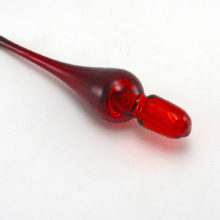
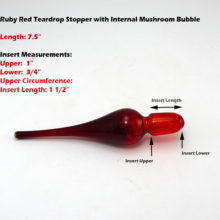
Mid-Century Modern decanter stopper teardrop in ruby red.
Hand-blown ruby red glass stopper measures 7.5″ long with internal mushroom bubble. Made in the U.S.A. during the Mid-Century Modern decor period (1940’s to 1970’s).
Please see image provided of the ruby glass stopper for exact measurements. It is in perfect condition.
This big mid-century modern decanter stopper in ruby red was made for the fabulously large decanters so popular back in the day they were produced, and still so very popular today but hard to find. Often we find the big decanter bottles without the stoppers because the stoppers are prone to break.
To determine if your stopper will fit your bottle:
Replacing missing stoppers is tricky. A good fit is essential. The measurements must match perfectly to the bottle neck opening in order to seal the air out and sit upright (without wiggling). Replaced stoppers are referred to as “married”, meaning the stopper is not original to the bottle.
- Measure the inner diameter of bottle neck opening. Use a soft tape measure to determine the width of the top opening. Measure the open space only, between the bottle neck opening. Do not include the glass rim of the bottle neck.
- The stopper’s ‘insert top’ (see image with measurements) should match the inner diameter (width) of the bottle neck opening exactly or just very slightly smaller. You can use your soft measuring tape to encircle the inner top opening to obtain the circumference.
- Most decanter bottle necks taper slightly down toward the vessel, resulting in a smaller neck measurement than the bottle neck opening. You should know the length of the insert. The insert is the portion of the stopper that enters the bottle neck opening.
- Take the measurement of the stopper’s insert length, from base to top of insert, and use your soft tape measure to determine where the stopper base will rest in your bottle neck. The stopper’s ‘insert base’ should measure exactly or just very slightly smaller than the measurement of the area of the bottle neck where it will rest when inserted.
Most stoppers made for the large decanters from the past have a ground area encircling the stopper base. These stoppers have been ‘ground to fit’ by the maker for the exact bottle they were made for. If you know how to grind glass, or know someone who does, you can have your stopper altered to fit your bottle. This can be done only with stopper inserts that are slightly larger than the bottle neck.
Trying to get a perfect ‘marriage’ between a vintage glass decanter and replacement stopper is not easy. Often, even when the measurements match up, thehttps://retroartglass.com/product-category/retro-art-glass/glass-forms/glass-decanters/glass-decanter-stopper/ stopper will tend to lean or wiggle. If your decanter is for decor purposes only, and you do not plan on using it as a decanter, you can put a small blob of putty or wax on the inner neck of the bottle to stabilize the stopper.
Click here to view all the marriageable stoppers available at Retro Art Glass.
-
SOLD
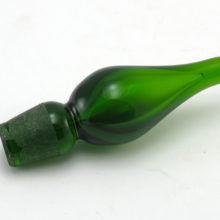
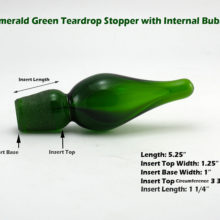
Vintage emerald green glass teardrop stopper for decanters, bottles or jugs.Hand-blown emerald green glass teardrop stopper measures 5¼” long. Internal teardrop bubble. Made in the U,S.A. or Italy during the Mid-Century Modern decor period (1940’s to 1970’s).
Please see image provided of the emerald green teardrop stopper for exact measurements. It is in perfect condition.
This mid-century modern vintage decanter stopper in emerald green was made for the fabulous decanters and bottles so popular back in the day they were produced, and still very popular today but hard to find. Often we find the decanter bottles without the stoppers because the stoppers are prone to break.
To determine if your stopper will fit your bottle:
Replacing missing stoppers is tricky. A good fit is essential. The measurements must match perfectly to the bottle neck opening in order to seal the air out and sit upright (without wiggling). Replaced stoppers are referred to as “married”, meaning the stopper is not original to the bottle.
- Measure the inner diameter of bottle neck opening. Use a soft tape measure to determine the width of the top opening. Measure the open space only, between the bottle neck opening. Do not include the glass rim of the bottle neck.
- The stopper’s ‘insert top’ (see image with measurements) should match the inner diameter (width) of the bottle neck opening exactly or just very slightly smaller. You can use your soft measuring tape to encircle the inner top opening to obtain the circumference.
- Most decanter bottle necks taper slightly down toward the vessel, resulting in a smaller neck measurement than the bottle neck opening. You should know the length of the insert. The insert is the portion of the stopper that enters the bottle neck opening.
- Take the measurement of the stopper’s insert length, from base to top of insert, and use your soft tape measure to determine where the stopper base will rest in your bottle neck. The stopper’s ‘insert base’ should measure exactly or just very slightly smaller than the measurement of the area of the bottle neck where it will rest when inserted.
Most stoppers made for the large decanters from the past have a ground area encircling the stopper base. These stoppers have been ‘ground to fit’ by the maker for the exact bottle they were made for. If you know how to grind glass, or know someone who does, you can have your stopper altered to fit your bottle. This can be done only with stopper inserts that are slightly larger than the bottle neck.
Trying to get a perfect ‘marriage’ between a vintage glass decanter and replacement stopper is not easy. Often, even when the measurements match up, the stopper will tend to lean or wiggle. If your decanter is for decor purposes only, and you do not plan on using it as a decanter, you can put a small blob of putty or wax on the inner neck of the bottle to stabilize the stopper.
Click here to view all the marriageable stoppers available at Retro Art Glass.
-
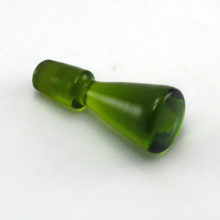
SOLD
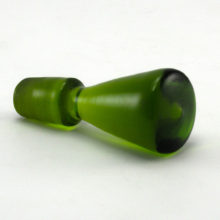
Small green glass stopper for perfume, jug or small decanter by Pilgrim Art Glass
Hand-formed grass green glass stopper measures 3 ¼” long. Made in the U,S.A. during the Mid-Century Modern decor period (1940’s to 1970’s). Probably made by Pilgrim Art Glass, U.S.A.)
Made of solid glass. It is in perfect condition. Please see image of the grass green glass stopper for exact measurements.
Often we find mid-century modern bottles without the stoppers because the stoppers are prone to break.
To determine if your stopper will fit your bottle:
Replacing missing stoppers is tricky. A good fit is essential. The measurements must match perfectly to the bottle neck opening in order to seal the air out and sit upright (without wiggling). Replaced stoppers are referred to as “married”, meaning the stopper is not original to the bottle.
- Measure the inner diameter of bottle neck opening. Use a soft tape measure to determine the width of the top opening. Measure the open space only, between the bottle neck opening. Do not include the glass rim of the bottle neck.
- The stopper’s ‘insert top’ (see image with measurements) should match the inner diameter (width) of the bottle neck opening exactly or just very slightly smaller. You can use your soft measuring tape to encircle the inner top opening to obtain the circumference.
- Most decanter bottle necks taper slightly down toward the vessel, resulting in a smaller neck measurement than the bottle neck opening. You should know the length of the insert. The insert is the portion of the stopper that enters the bottle neck opening.
- Take the measurement of the stopper’s insert length, from base to top of insert, and use your soft tape measure to determine where the stopper base will rest in your bottle neck. The stopper’s ‘insert base’ should measure exactly or just very slightly smaller than the measurement of the area of the bottle neck where it will rest when inserted.
Most stoppers from the past have a ground area encircling the stopper base. These stoppers have been ‘ground to fit’ by the maker for the exact bottle they were made for. If you know how to grind glass, or know someone who does, you can have your stopper altered to fit your bottle. This can be done only with stopper inserts that are slightly larger than the bottle neck.
Trying to get a perfect ‘marriage’ between a vintage glass bottle and replacement stopper is not easy. Often, even when the measurements match up, the stopper will tend to lean or wiggle. If your decanter is for decor purposes only, and you do not plan on using it as a decanter, you can put a small blob of putty or wax on the inner neck of the bottle to stabilize the stopper.
Click here to view all the marriageable stoppers available at Retro Art Glass.
-
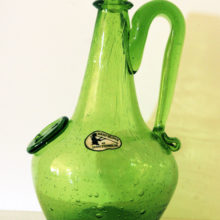
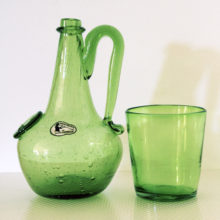 $75.00
Early American style Jamestown Glass handled jug in bubbly glass with applied seal.
This old Jamestown Glass jug is a vintage reproduction of antique Early American glass made during the medieval revival of the 1960’s. It was heated at the furnace, blown by mouth and finished by hand with applied lip, handle and seal…just like glass makers did in the early days of American colonization.
The jug is full-size, just like you’d see on the American settlers tables or bars. Label still attached, reads – Hand Blown at Jamestown, VA. – The specialty ‘Jamestown’ line has been associated with Blenko Art Glass. Blenko created the line with inspiration provided by the early American Jamestown Glasshouse.
Loaded with bubbles, from extra tiny to long and stretched, as glass from early wood-burning furnaces have. Inverted soft pontil mark. Applied handle, lip and seal. The round disc on the front is a seal. Seals were often applied on glass made in America’s very early years.
Big jug is in excellent condition. Perfect for serving your home-made Sangria, etc. Beautiful sitting in a large window sill. Makes a great vase too. Measures 8.25″ tall and 5.5″ at widest. Weighs 2.5 lbs.
-
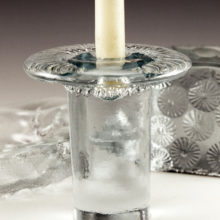
 $45.00
Blenko Art Glass Tall Mushroom Candlestick Holder with Original Sticker
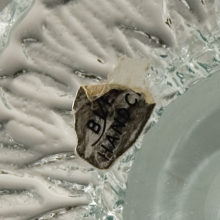
Big mushroom candlestick holder by Blenko Art Glass, circa 1970-1980. Remains of Blenko’s silver foil hand label still attached. This label was first used in the 1930’s and discontinued in 1982, but was used until the supply was deleted.
Shown in origional Blenko catalogs as part no. 77L, largest of three sizes available. Designed by Don Shepherd who worked at Blenko from 1974 to 1988.
Big, chunky colorless glass formed in wood or clay molds. The surface of the mushroom cap is smooth with the texture of the mushroom gills beneath.
Solid handmade mold-formed glass mushroom candlestick holder with no seam lines. Weighs 3 lbs. Fits the standard taper candlestick. Measures 5″ tall with a 5″ wide cap. In excellent condition.