Showing 91–120 of 205 resultsSorted by latest
-
 $40.00
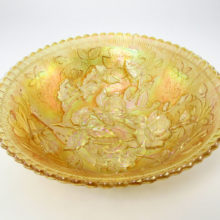
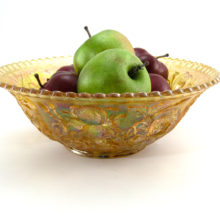
Imperial Glass Open Rose Rubigold Lustre 10″ Bowl Vintage
This large Imperial Glass Open Rose Rubigold bowl measures 10″ round, 3¾” tall and weighs 2.2 lbs. Made of quality, thick vintage glass. The pattern ‘Open Rose’ is deep and detailed. Sometimes you’ll find dulled, almost blurred patterns on antique or vintage pattern glass due to an aging, overused mold. This bowl’s pattern is sharp and clear. It is in excellent condition.
Imperial Glass began making Carnival Glass around 1908. In 1962 Imperial made the first reissues of their Carnival pattern glass. Most, but not all, items from this period were marked with the well known IG. The color ‘Rubigold’ was produced only between 1965 and 1972. This bowl was not marked with the IG on the base.
Beautiful color with shy hints of Ruby highlights within the iridescent gold carnival glass. Lovely bowl for your table or as a hostess gift filled with goodies.
-
 $90.00
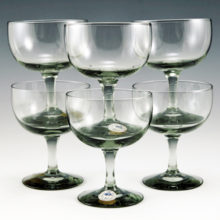
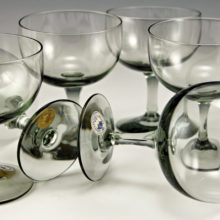
Hand blown Danish Modern crystal cocktail set in like-new condition with box.
Elegant, high-end Danish Modern crystal. This series was called ‘Elsinore’ and was made in different sizes and colors in stemware and pitchers.
Four of the six cocktail stems retain the original ‘Kastrup Holmegaard‘ label. This label was first used in 1965 and was changed in 1975 when Kastrup (a very, very old Danish glass making company) was dropped from the label.
They are all in excellent condition. Beautiful, well-made glass. The bowl, stem and foot were hand-blown separately and then applied to each other. Smoke grey color with just a hint of smoke olive green.
The box took a beating, but the cocktail stems survived. It’s so nice to have the box because it identifies the series name. Measure 3.75″ tall with a 3″ wide mouth. Holmegaard part no. G6736 (found inside box). Circa 1965 to early 1970’s.
-
 $115.00
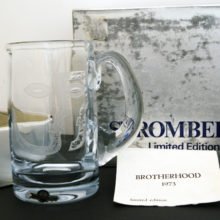
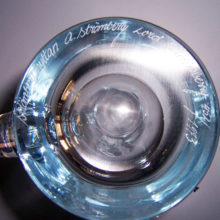
This fabulous and rare crystal beer mug is hand-etched, signed and numbered ‘Strombergshyttan, A. Stromberg, Lord Queensberry, 452/1973’. It also has the original label attached to the glass. It was made in 1973, limited edition of 3500. Unused in original box.
Strombergshyttan, a member of the ‘Kingdom of Crystal‘, was founded in 1876, Sweden as Lindfors glassworks. Edward Stromberg, the former head of Orrefors, took over in 1933. Asta Stromberg made this mug in 1973. She was married to Eric Stromberg, son of Edward, who died in 1960. She continued the family business until a major fire wiped out the factory finances and the company was sold to Orrefors.
Very difficult to image the color of the glass. The crystal beer mug has a bluish silver hue, a specialty color of the factory, see image 3 for best color example. Hand blown with applied handle. The impressionist face is engraved and deep acid-etched with textures. Pontil mark is a polished concave circle. Big mug weighs 2 lbs and measures just under 6″ tall. Box has foam fitted padding on both sides to cradle the mug while stored.
The mug is in excellent condition. The box is in worn stored condition. Read the pamphlet that comes with it in image 5. The Marquis of Queensberry was involved with the mug decor, perhaps the designer of the face.
-
 $110.00
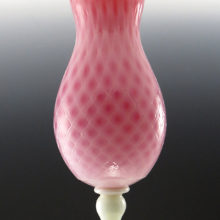
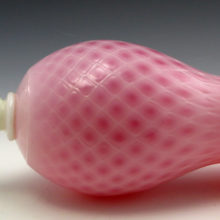
Tall Diamond Quilted Glass Vase with Alabaster Foot
Elegant, eye-catching diamond quilted glass vase with applied two-part alabaster glass foot. Vase measures 11″ tall. Big, beautiful vase can hold a large bunch of flowers.
Made by blowing two layers of glass into a diamond pattern mold. The creamy white glass (called alabaster) used on the stem and foot was hand-made in two parts and applied to the vase. The inner layer is a very dark salmon color. The 4″ wide vase opening was ruffled with blow-torch and hand tool.
Probably created in Italy for export to the U.S., but it could be early 20th Century American made. The diamond quilted cut velvet decor was popular in the Victorian era. The decor style regained popularity in the 1940’s to 1950’s.
The applied two part stem and foot point to a quality maker. Victorian era glass often sported this style of foot. During the Mid-20th Century, major Italian glass houses exported vases like this to decor distributors in the U.S. Estimated circa: 1920 to 1960.
This vase is in excellent condition.
-
 $60.00
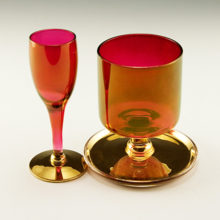
Antique elegant ruby blown glass with a golden glow.
Have a smoke and a little spirit in elegant style! Beautiful ruby blown glass goblet and cigarette or paraphernalia holder. Rich golden ruby color achieved using real gold from yesteryear.
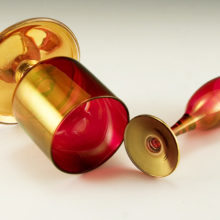
In great + condition. It’s rare to find antique glass in this decor style without wear. This set is almost perfect with a few tiny pinholes and scratches of wear on the gold surface that cannot be seen unless held up to the light. The gold appears perfect under normal conditions. The flashed gold ruby is in excellent condition, bright and with a glowing gold reflection. No chips or cracks.
The cigarette holder style was made by elegant glass makers of the early 1900’s to the 1940’s. Looks like it may be by Cambridge Glass, an elegant maker of the era. This set is at least 70 years old.
The holder is 3.5″ tall with a 3.5″ base. Its turned up base was meant to be an ashtray, but don’t use it as one. The decor is delicate and will not hold up to grinding hot ashes into it. It could be used as a matchstick or other paraphernalia holder. The liquor glass stem is 4.25″ tall.
Both items are hand-blown with pontil marks. The bases are applied to the vessels. -
 $370.00
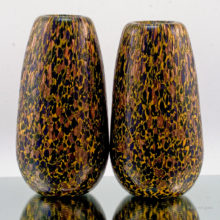
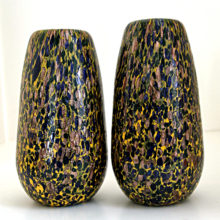
Big hand blown art glass vase set with exterior polychrome and aventurine murrina décor.
Mysterious hand blown art glass vase set. We are unable to identify the maker or the era at this time. The only decor match we’ve found was described as “vasa Murrhina”, but it was on a vase from the first century A.D. This unique pair of vases are not from the first century. They were probably made in the 1940’s-1960’s.
They could be mid-century Italian/Murano/Venetian: Pezzato (Venini), Mosaica (Vistosi/Toso) or AVEM (Dino Martens). This high quality hand blown art glass vase set was certainly made by a master of the craft. Estimated circa 1920 – 1960.
The exterior décor process is called “Roll Up” or “laminated”. Colorful sheets of glass produced with kiln-fusing are rolled over the blown vessel, then attached to a blow pipe and blown again. It involves warm, hot, and cold methods all in unison. Very difficult to achieve.
The inner glass is blown cobalt blue (image 7). The laminated layer is not cased in clear as usually seen, it is the outer layer. Surface is textured. Multiple images included here due to difficulty in capturing the intense beauty of the vases. The laminate colors are blue, yellow, and copper aventurine. The laminate is wrapped over the vase openings which creates a stunning decor effect.
The vases are large and heavy. Measure 9.25 & 9.5″ tall, Weigh 3.75 lbs each. Slightly different height and shape on each is due the hand blowing process. Interesting soft form bullet shapes. Both in excellent condition with roughly ground pontil marks.
-
 $70.00
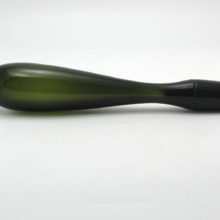
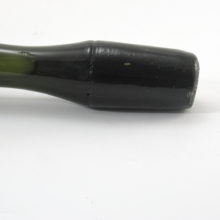
Vintage decanter stopper extra tall in dark olive green glass.
Hand-made solid glass stopper measures 9.75″ long. Made in the U.S.A. during the Mid-Century Modern decor period (1940’s to 1970’s).
Please see image provided of the olive green baton stopper for exact measurements. It is in perfect condition.
This big mid-century modern vintage decanter stopper in olive green was made for the fabulously large decanters so popular back in the day they were produced, and still so very popular today but hard to find. Often we find the big decanter bottles without the stoppers because the stoppers are prone to break.
To determine if your stopper will fit your bottle:
Replacing missing stoppers is tricky. A good fit is essential. The measurements must match perfectly to the bottle neck opening in order to seal the air out and sit upright (without wiggling). Replaced stoppers are referred to as “married”, meaning the stopper is not original to the bottle.
- Measure the inner diameter of bottle neck opening. Use a soft tape measure to determine the width of the top opening. Measure the open space only, between the bottle neck opening. Do not include the glass rim of the bottle neck.
- The stopper’s ‘insert top’ (see image with measurements) should match the inner diameter (width) of the bottle neck opening exactly or just very slightly smaller. You can use your soft measuring tape to encircle the inner top opening to obtain the circumference.
- Most decanter bottle necks taper slightly down toward the vessel, resulting in a smaller neck measurement than the bottle neck opening. You should know the length of the insert. The insert is the portion of the stopper that enters the bottle neck opening.
- Take the measurement of the stopper’s insert length, from base to top of insert, and use your soft tape measure to determine where the stopper base will rest in your bottle neck. The stopper’s ‘insert base’ should measure exactly or just very slightly smaller than the measurement of the area of the bottle neck where it will rest when inserted.
Most stoppers made for the large decanters from the past have a ground area encircling the stopper base. These stoppers have been ‘ground to fit’ by the maker for the exact bottle they were made for. If you know how to grind glass, or know someone who does, you can have your stopper altered to fit your bottle. This can be done only with stopper inserts that are slightly larger than the bottle neck.
Trying to get a perfect ‘marriage’ between a vintage glass decanter and replacement stopper is not easy. Often, even when the measurements match up, the stopper will tend to lean or wiggle. If your decanter is for decor purposes only, and you do not plan on using it as a decanter, you can put a small blob of putty or wax on the inner neck of the bottle to stabilize the stopper.
Click here to view all the marriageable stoppers available at Retro Art Glass.
-
 $20.00
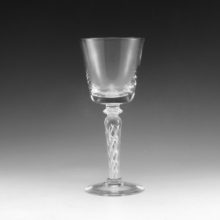
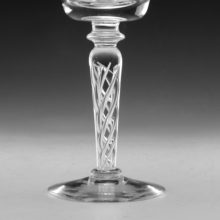
Vintage air twist stem wine glass. Maker unknown. Steuben glass is best known for their air twist stemware and other bar ware.
Beautifully done air twist, see stem image closeup. The glass artist inserted the air bubbles into the glass, then elongated and twisted the bubbles.
Stands 5″ tall. Stem was applied to foot and bowl. In perfect condition.
-
SOLD
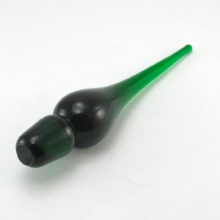
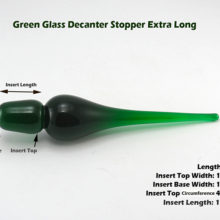
Retro decanter stopper teardrop in green glass with internal bubble.
Hand-blown retro decanter stopper in green glass measures 10″ long. Solid glass. Made in the U.S.A. during the Mid-Century Modern decor period (1940’s to 1970’s).
It is in perfect condition. Please see the image provided of this green teardrop retro decanter stopper for exact measurements.
These big stoppers were made for the fabulously large decanters so popular back in the day they were produced, and still so very popular today but hard to find. Often we find the big decanter bottles without the stoppers because the stoppers are prone to break.
To determine if your stopper will fit your bottle:
Replacing missing stoppers is tricky. A good fit is essential. The measurements must match perfectly to the bottle neck opening in order to seal the air out and sit upright (without wiggling). Replaced stoppers are referred to as “married”, meaning the stopper is not original to the bottle.
- Measure the inner diameter of bottle neck opening. Use a soft tape measure to determine the width of the top opening. Measure the open space only, between the bottle neck opening. Do not include the glass rim of the bottle neck.
- The stopper’s ‘insert top’ (see image with measurements) should match the inner diameter (width) of the bottle neck opening exactly or just very slightly smaller. You can use your soft measuring tape to encircle the inner top opening to obtain the circumference.
- Most decanter bottle necks taper slightly down toward the vessel, resulting in a smaller neck measurement than the bottle neck opening. You should know the length of the insert. The insert is the portion of the stopper that enters the bottle neck opening.
- Take the measurement of the stopper’s insert length, from base to top of insert, and use your soft tape measure to determine where the stopper base will rest in your bottle neck. The stopper’s ‘insert base’ should measure exactly or just very slightly smaller than the measurement of the area of the bottle neck where it will rest when inserted.
Most stoppers made for the large decanters from the past have a ground area encircling the stopper base. These stoppers have been ‘ground to fit’ by the maker for the exact bottle they were made for. If you know how to grind glass, or know someone who does, you can have your stopper altered to fit your bottle. This can be done only with stopper inserts that are slightly larger than the bottle neck.
Trying to get a perfect ‘marriage’ between a vintage glass decanter and replacement stopper is not easy. Often, even when the measurements match up, the stopper will tend to lean or wiggle. If your decanter is for decor purposes only, and you do not plan on using it as a decanter, you can put a small blob of putty or wax on the inner neck of the bottle to stabilize the stopper.
Click here to view all the marriageable stoppers available at Retro Art Glass.
-
SOLD
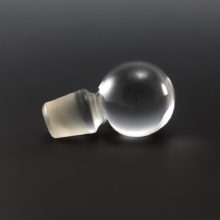
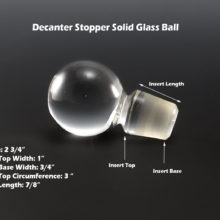
Small crystal ball stopper will fit smaller decanters, cruets, jugs and perfume bottles.
Made of solid glass with a few trapped air bubbles in the ball. In excellent condition.
Use the measurements shown in the image to determine if this small crystal ball stopper will fit your container.
To determine if your stopper will fit your bottle:
Replacing missing stoppers is tricky. A good fit is essential. The measurements must match perfectly to the bottle neck opening in order to seal the air out and sit upright (without wiggling). Replaced stoppers are referred to as “married”, meaning the stopper is not original to the bottle.
- Measure the inner diameter of bottle neck opening. Use a soft tape measure to determine the width of the top opening. Measure the open space only, between the bottle neck opening. Do not include the glass rim of the bottle neck.
- The stopper’s ‘insert top’ (see image with measurements) should match the inner diameter (width) of the bottle neck opening exactly or just very slightly smaller. You can use your soft measuring tape to encircle the inner top opening to obtain the circumference.
- Most decanter bottle necks taper slightly down toward the vessel, resulting in a smaller neck measurement than the bottle neck opening. You should know the length of the insert. The insert is the portion of the stopper that enters the bottle neck opening.
- Take the measurement of the stopper’s insert length, from base to top of insert, and use your soft tape measure to determine where the stopper base will rest in your bottle neck. The stopper’s ‘insert base’ should measure exactly or just very slightly smaller than the measurement of the area of the bottle neck where it will rest when inserted.
Most stoppers made for the decanters from the past have a ground area encircling the stopper base. These stoppers have been ‘ground to fit’ by the maker for the exact bottle they were made for. If you know how to grind glass, or know someone who does, you can have your stopper altered to fit your bottle. This can be done only with stopper inserts that are slightly larger than the bottle neck.
Trying to get a perfect ‘marriage’ between a vintage glass decanter and replacement stopper is not easy. Often, even when the measurements match up, the stopper will tend to lean or wiggle. If your decanter is for decor purposes only, and you do not plan on using it as a decanter, you can put a small blob of putty or wax on the inner neck of the bottle to stabilize the stopper.
Click here to view all the marriageable stoppers available at Retro Art Glass.
-
 $15.00
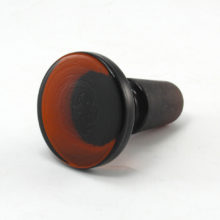
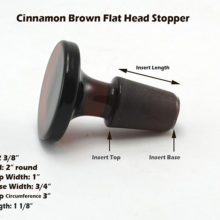
Brown glass stopper, color also known as ‘Root Beer’, for bottles, jugs, apothecary, or small decanters
Hand-made brown glass stopper measures 2 3/8″” long. Unknown origin, probably made in the early 1900’s. May have been an apothecary jar stopper.
It is in perfect condition. Please see the image provided of this brown glass stopper for exact measurements.
Often we find the decanter bottles without the stoppers because the stoppers are prone to break.
To determine if your stopper will fit your bottle:
Replacing missing stoppers is tricky. A good fit is essential. The measurements must match perfectly to the bottle neck opening in order to seal the air out and sit upright (without wiggling). Replaced stoppers are referred to as “married”, meaning the stopper is not original to the bottle.
- Measure the inner diameter of bottle neck opening. Use a soft tape measure to determine the width of the top opening. Measure the open space only, between the bottle neck opening. Do not include the glass rim of the bottle neck.
- The stopper’s ‘insert top’ (see image with measurements) should match the inner diameter (width) of the bottle neck opening exactly or just very slightly smaller. You can use your soft measuring tape to encircle the inner top opening to obtain the circumference.
- Most decanter bottle necks taper slightly down toward the vessel, resulting in a smaller neck measurement than the bottle neck opening. You should know the length of the insert. The insert is the portion of the stopper that enters the bottle neck opening.
- Take the measurement of the stopper’s insert length, from base to top of insert, and use your soft tape measure to determine where the stopper base will rest in your bottle neck. The stopper’s ‘insert base’ should measure exactly or just very slightly smaller than the measurement of the area of the bottle neck where it will rest when inserted.
Most stoppers made for the large decanters from the past have a ground area encircling the stopper base. These stoppers have been ‘ground to fit’ by the maker for the exact bottle they were made for. If you know how to grind glass, or know someone who does, you can have your stopper altered to fit your bottle. This can be done only with stopper inserts that are slightly larger than the bottle neck.
Trying to get a perfect ‘marriage’ between a vintage glass decanter and replacement stopper is not easy. Often, even when the measurements match up, the stopper will tend to lean or wiggle. If your decanter is for decor purposes only, and you do not plan on using it as a decanter, you can put a small blob of putty or wax on the inner neck of the bottle to stabilize the stopper.
Click here to view all the marriageable stoppers available at Retro Art Glass.
-
SOLD
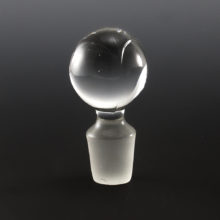
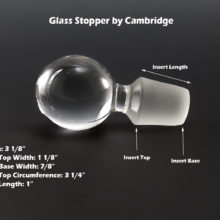
Cambridge glass stopper for #3400/92, 32 ounce ball decanter.
This Cambridge glass stopper fits their 1940’s ball decanter, but it can fit other decanters too. See image for exact measurements.
The pressed glass stopper has a square impression on the top, hard to see in the images. It is in excellent condition.
To determine if your stopper will fit your bottle:
Replacing missing stoppers is tricky. A good fit is essential. The measurements must match perfectly to the bottle neck opening in order to seal the air out and sit upright (without wiggling). Replaced stoppers are referred to as “married”, meaning the stopper is not original to the bottle.
- Measure the inner diameter of bottle neck opening. Use a soft tape measure to determine the width of the top opening. Measure the open space only, between the bottle neck opening. Do not include the glass rim of the bottle neck.
- The stopper’s ‘insert top’ (see image with measurements) should match the inner diameter (width) of the bottle neck opening exactly or just very slightly smaller. You can use your soft measuring tape to encircle the inner top opening to obtain the circumference.
- Most decanter bottle necks taper slightly down toward the vessel, resulting in a smaller neck measurement than the bottle neck opening. You should know the length of the insert. The insert is the portion of the stopper that enters the bottle neck opening.
- Take the measurement of the stopper’s insert length, from base to top of insert, and use your soft tape measure to determine where the stopper base will rest in your bottle neck. The stopper’s ‘insert base’ should measure exactly or just very slightly smaller than the measurement of the area of the bottle neck where it will rest when inserted.
Most stoppers made for the decanters from the past have a ground area encircling the stopper base. These stoppers have been ‘ground to fit’ by the maker for the exact bottle they were made for. If you know how to grind glass, or know someone who does, you can have your stopper altered to fit your bottle. This can be done only with stopper inserts that are slightly larger than the bottle neck.
Trying to get a perfect ‘marriage’ between a vintage glass decanter and replacement stopper is not easy. Often, even when the measurements match up, the stopper will tend to lean or wiggle. If your decanter is for decor purposes only, and you do not plan on using it as a decanter, you can put a small blob of putty or wax on the inner neck of the bottle to stabilize the stopper.
Click here to view all the marriageable stoppers available at Retro Art Glass.
-
 $45.00
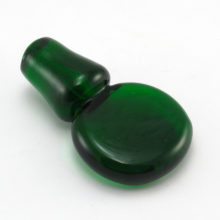
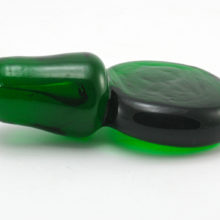
Big vintage emerald green glass stopper for decanters with disc topper.
Hand-made solid emerald green glass stopper measures 5″ long. Made in the U.S.A. during the Mid-Century Modern decor period (1940’s to 1970’s). Solid glass.
Please see image provided of the emerald green disc stopper for exact measurements. Probably made in Italy or by Blenko Art Glass. It is in perfect condition.
This big mid-century modern vintage decanter stopper in emerald green was made for the fabulously large decanters so popular back in the day they were produced, and still so very popular today but hard to find. Often we find the big decanter bottles without the stoppers because the stoppers are prone to break.
To determine if your stopper will fit your bottle:
Replacing missing stoppers is tricky. A good fit is essential. The measurements must match perfectly to the bottle neck opening in order to seal the air out and sit upright (without wiggling). Replaced stoppers are referred to as “married”, meaning the stopper is not original to the bottle.
- Measure the inner diameter of bottle neck opening. Use a soft tape measure to determine the width of the top opening. Measure the open space only, between the bottle neck opening. Do not include the glass rim of the bottle neck.
- The stopper’s ‘insert top’ (see image with measurements) should match the inner diameter (width) of the bottle neck opening exactly or just very slightly smaller. You can use your soft measuring tape to encircle the inner top opening to obtain the circumference.
- Most decanter bottle necks taper slightly down toward the vessel, resulting in a smaller neck measurement than the bottle neck opening. You should know the length of the insert. The insert is the portion of the stopper that enters the bottle neck opening.
- Take the measurement of the stopper’s insert length, from base to top of insert, and use your soft tape measure to determine where the stopper base will rest in your bottle neck. The stopper’s ‘insert base’ should measure exactly or just very slightly smaller than the measurement of the area of the bottle neck where it will rest when inserted.
Most stoppers made for the large decanters from the past have a ground area encircling the stopper base. These stoppers have been ‘ground to fit’ by the maker for the exact bottle they were made for. If you know how to grind glass, or know someone who does, you can have your stopper altered to fit your bottle. This can be done only with stopper inserts that are slightly larger than the bottle neck.
Trying to get a perfect ‘marriage’ between a vintage glass decanter and replacement stopper is not easy. Often, even when the measurements match up, the stopper will tend to lean or wiggle. If your decanter is for decor purposes only, and you do not plan on using it as a decanter, you can put a small blob of putty or wax on the inner neck of the bottle to stabilize the stopper.
Click here to view all the marriageable stoppers available at Retro Art Glass.
-
 $65.00
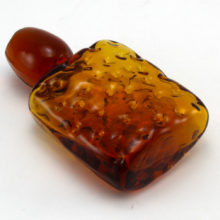
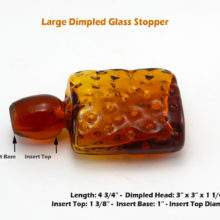
Big hand-blown decanter stopper in glowing amber with dimples
Hand-blown decanter stopper measures 4″ long. Made in the U.S.A. during the Mid-Century Modern decor period (1940’s to 1970’s). Probably made by Blenko Art Glass.
It is in perfect condition. Please see image of the dimpled amber glass stopper for exact measurements.
These big stoppers were made for the fabulously large decanters so popular back in the day they were produced, and still so very popular today but hard to find. Often we find the big decanter bottles without the stoppers because the stoppers are prone to break.
Replacing missing stoppers is tricky. A good fit is essential. The measurements must match perfectly to the bottle neck opening in order to seal out the air and sit upright (without wiggling). Replaced stoppers are referred to as “married”, meaning the stopper is not original to the bottle.
To determine if your stopper will fit your bottle:
- Measure the inner diameter of bottle neck opening. Use a soft tape measure to determine the width of the opening. Measure the open space only between the bottle neck opening. Do not include the glass rim of the bottle neck.
- The stopper’s ‘insert top’ (see image with measurements) should match the inner diameter of the bottle neck opening exactly or just very slightly smaller. You can determine the circumference measurement by wrapping a soft measuring tape around the inner top of the bottle neck.
- Most decanter bottle necks taper slightly down toward the vessel, resulting in a smaller neck measurement than the bottle neck opening. You should know the length of the insert. The insert is the portion of the stopper that enters the bottle neck opening.
- Take the measurement of the stopper’s insert from base to top of insert, and use your soft tape measure to determine where the stopper base will rest in your bottle neck. The stopper’s ‘insert base’ should measure exactly or just very slightly smaller than the measurement of the area of the bottle neck where it will rest when inserted.
Most stoppers made for the large decanters from the past have a ground area encircling the stopper base. These stoppers have been ‘ground to fit’ by the maker for the exact bottle they were made for. If you know how to grind glass, or know someone who does, you can have your stopper altered to fit your bottle. This can be done only with stopper inserts that are slightly larger than the bottle neck.
Trying to get a perfect ‘marriage’ between a vintage glass decanter and replacement stopper is not easy. Often, even when the measurements match up, the stopper will tend to lean or wiggle. If your decanter is for decor purposes only, and you do not plan on using it as a decanter, you can put a small blob of putty or wax on the inner neck of the bottle to stabilize the stopper.
Click here to view all the marriageable stoppers available at Retro Art Glass.
-
 $25.00
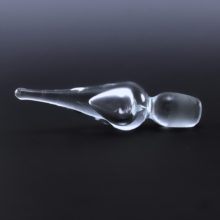
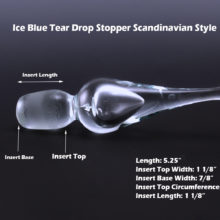
Ice Blue Scandinavian glass stopper made for the beautiful decanters made in the Nordic countries during the mid-20th Century which have a slight hint of blue. This stopper would look nice with colorless or darker blue decanters or bottles too.
Measures 5¼” long. See image of the ice blue Scandinavian glass stopper for exact measurements to determine if it will fit your bottle.
Has an interior double teardrop bubble. In excellent condition.
To determine if your stopper will fit your bottle:
Replacing missing stoppers is tricky. A good fit is essential. The measurements must match perfectly to the bottle neck opening in order to seal the air out and sit upright (without wiggling). Replaced stoppers are referred to as “married”, meaning the stopper is not original to the bottle.
- Measure the inner diameter of bottle neck opening. Use a soft tape measure to determine the width of the top opening. Measure the open space only, between the bottle neck opening. Do not include the glass rim of the bottle neck.
- The stopper’s ‘insert top’ (see image with measurements) should match the inner diameter (width) of the bottle neck opening exactly or just very slightly smaller. You can use your soft measuring tape to encircle the inner top opening to obtain the circumference.
- Most decanter bottle necks taper slightly down toward the vessel, resulting in a smaller neck measurement than the bottle neck opening. You should know the length of the insert. The insert is the portion of the stopper that enters the bottle neck opening.
- Take the measurement of the stopper’s insert length, from base to top of insert, and use your soft tape measure to determine where the stopper base will rest in your bottle neck. The stopper’s ‘insert base’ should measure exactly or just very slightly smaller than the measurement of the area of the bottle neck where it will rest when inserted.
Most stoppers made for the decanters from the past have a ground area encircling the stopper base. These stoppers have been ‘ground to fit’ by the maker for the exact bottle they were made for. If you know how to grind glass, or know someone who does, you can have your stopper altered to fit your bottle. This can be done only with stopper inserts that are slightly larger than the bottle neck.
Trying to get a perfect ‘marriage’ between a vintage glass decanter and replacement stopper is not easy. Often, even when the measurements match up, the stopper will tend to lean or wiggle. If your decanter is for decor purposes only, and you do not plan on using it as a decanter, you can put a small blob of putty or wax on the inner neck of the bottle to stabilize the stopper.
Click here to view all the marriageable stoppers available at Retro Art Glass.
-
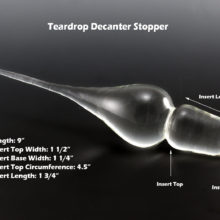
SOLD
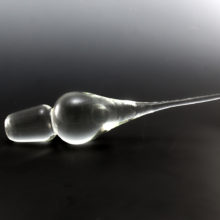
Large crystal stopper for mid-20th century decanter. Measures 9″ long. Teardrop form. Hand-made of solid glass.
Colorless stoppers look great with colored glass bottles. This large crystal stopper is in excellent condition.
Use the measurements provided in image to determine if this large crystal stopper will fit your bottle.
To determine if your stopper will fit your bottle:
Replacing missing stoppers is tricky. A good fit is essential. The measurements must match perfectly to the bottle neck opening in order to seal the air out and sit upright (without wiggling). Replaced stoppers are referred to as “married”, meaning the stopper is not original to the bottle.
- Measure the inner diameter of bottle neck opening. Use a soft tape measure to determine the width of the top opening. Measure the open space only, between the bottle neck opening. Do not include the glass rim of the bottle neck.
- The stopper’s ‘insert top’ (see image with measurements) should match the inner diameter (width) of the bottle neck opening exactly or just very slightly smaller. You can use your soft measuring tape to encircle the inner top opening to obtain the circumference.
- Most decanter bottle necks taper slightly down toward the vessel, resulting in a smaller neck measurement than the bottle neck opening. You should know the length of the insert. The insert is the portion of the stopper that enters the bottle neck opening.
- Take the measurement of the stopper’s insert length, from base to top of insert, and use your soft tape measure to determine where the stopper base will rest in your bottle neck. The stopper’s ‘insert base’ should measure exactly or just very slightly smaller than the measurement of the area of the bottle neck where it will rest when inserted.
Most stoppers made for the decanters from the past have a ground area encircling the stopper base. These stoppers have been ‘ground to fit’ by the maker for the exact bottle they were made for. If you know how to grind glass, or know someone who does, you can have your stopper altered to fit your bottle. This can be done only with stopper inserts that are slightly larger than the bottle neck.
Trying to get a perfect ‘marriage’ between a vintage glass decanter and replacement stopper is not easy. Often, even when the measurements match up, the stopper will tend to lean or wiggle. If your decanter is for decor purposes only, and you do not plan on using it as a decanter, you can put a small blob of putty or wax on the inner neck of the bottle to stabilize the stopper.
Click here to view all the marriageable stoppers available at Retro Art Glass.
-
SOLD
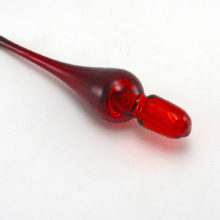
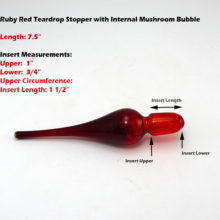
Mid-Century Modern decanter stopper teardrop in ruby red.
Hand-blown ruby red glass stopper measures 7.5″ long with internal mushroom bubble. Made in the U.S.A. during the Mid-Century Modern decor period (1940’s to 1970’s).
Please see image provided of the ruby glass stopper for exact measurements. It is in perfect condition.
This big mid-century modern decanter stopper in ruby red was made for the fabulously large decanters so popular back in the day they were produced, and still so very popular today but hard to find. Often we find the big decanter bottles without the stoppers because the stoppers are prone to break.
To determine if your stopper will fit your bottle:
Replacing missing stoppers is tricky. A good fit is essential. The measurements must match perfectly to the bottle neck opening in order to seal the air out and sit upright (without wiggling). Replaced stoppers are referred to as “married”, meaning the stopper is not original to the bottle.
- Measure the inner diameter of bottle neck opening. Use a soft tape measure to determine the width of the top opening. Measure the open space only, between the bottle neck opening. Do not include the glass rim of the bottle neck.
- The stopper’s ‘insert top’ (see image with measurements) should match the inner diameter (width) of the bottle neck opening exactly or just very slightly smaller. You can use your soft measuring tape to encircle the inner top opening to obtain the circumference.
- Most decanter bottle necks taper slightly down toward the vessel, resulting in a smaller neck measurement than the bottle neck opening. You should know the length of the insert. The insert is the portion of the stopper that enters the bottle neck opening.
- Take the measurement of the stopper’s insert length, from base to top of insert, and use your soft tape measure to determine where the stopper base will rest in your bottle neck. The stopper’s ‘insert base’ should measure exactly or just very slightly smaller than the measurement of the area of the bottle neck where it will rest when inserted.
Most stoppers made for the large decanters from the past have a ground area encircling the stopper base. These stoppers have been ‘ground to fit’ by the maker for the exact bottle they were made for. If you know how to grind glass, or know someone who does, you can have your stopper altered to fit your bottle. This can be done only with stopper inserts that are slightly larger than the bottle neck.
Trying to get a perfect ‘marriage’ between a vintage glass decanter and replacement stopper is not easy. Often, even when the measurements match up, thehttps://retroartglass.com/product-category/retro-art-glass/glass-forms/glass-decanters/glass-decanter-stopper/ stopper will tend to lean or wiggle. If your decanter is for decor purposes only, and you do not plan on using it as a decanter, you can put a small blob of putty or wax on the inner neck of the bottle to stabilize the stopper.
Click here to view all the marriageable stoppers available at Retro Art Glass.
-
SOLD
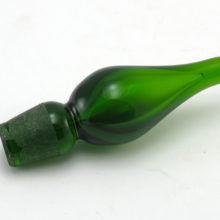
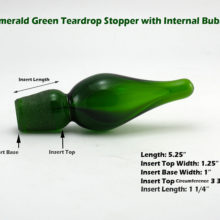
Vintage emerald green glass teardrop stopper for decanters, bottles or jugs.Hand-blown emerald green glass teardrop stopper measures 5¼” long. Internal teardrop bubble. Made in the U,S.A. or Italy during the Mid-Century Modern decor period (1940’s to 1970’s).
Please see image provided of the emerald green teardrop stopper for exact measurements. It is in perfect condition.
This mid-century modern vintage decanter stopper in emerald green was made for the fabulous decanters and bottles so popular back in the day they were produced, and still very popular today but hard to find. Often we find the decanter bottles without the stoppers because the stoppers are prone to break.
To determine if your stopper will fit your bottle:
Replacing missing stoppers is tricky. A good fit is essential. The measurements must match perfectly to the bottle neck opening in order to seal the air out and sit upright (without wiggling). Replaced stoppers are referred to as “married”, meaning the stopper is not original to the bottle.
- Measure the inner diameter of bottle neck opening. Use a soft tape measure to determine the width of the top opening. Measure the open space only, between the bottle neck opening. Do not include the glass rim of the bottle neck.
- The stopper’s ‘insert top’ (see image with measurements) should match the inner diameter (width) of the bottle neck opening exactly or just very slightly smaller. You can use your soft measuring tape to encircle the inner top opening to obtain the circumference.
- Most decanter bottle necks taper slightly down toward the vessel, resulting in a smaller neck measurement than the bottle neck opening. You should know the length of the insert. The insert is the portion of the stopper that enters the bottle neck opening.
- Take the measurement of the stopper’s insert length, from base to top of insert, and use your soft tape measure to determine where the stopper base will rest in your bottle neck. The stopper’s ‘insert base’ should measure exactly or just very slightly smaller than the measurement of the area of the bottle neck where it will rest when inserted.
Most stoppers made for the large decanters from the past have a ground area encircling the stopper base. These stoppers have been ‘ground to fit’ by the maker for the exact bottle they were made for. If you know how to grind glass, or know someone who does, you can have your stopper altered to fit your bottle. This can be done only with stopper inserts that are slightly larger than the bottle neck.
Trying to get a perfect ‘marriage’ between a vintage glass decanter and replacement stopper is not easy. Often, even when the measurements match up, the stopper will tend to lean or wiggle. If your decanter is for decor purposes only, and you do not plan on using it as a decanter, you can put a small blob of putty or wax on the inner neck of the bottle to stabilize the stopper.
Click here to view all the marriageable stoppers available at Retro Art Glass.
-
SOLD
Small green glass stopper for perfume, jug or small decanter by Pilgrim Art Glass
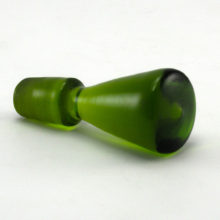
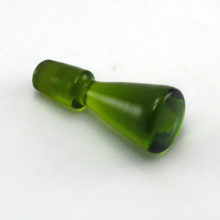
Hand-formed grass green glass stopper measures 3 ¼” long. Made in the U,S.A. during the Mid-Century Modern decor period (1940’s to 1970’s). Probably made by Pilgrim Art Glass, U.S.A.)
Made of solid glass. It is in perfect condition. Please see image of the grass green glass stopper for exact measurements.
Often we find mid-century modern bottles without the stoppers because the stoppers are prone to break.
To determine if your stopper will fit your bottle:
Replacing missing stoppers is tricky. A good fit is essential. The measurements must match perfectly to the bottle neck opening in order to seal the air out and sit upright (without wiggling). Replaced stoppers are referred to as “married”, meaning the stopper is not original to the bottle.
- Measure the inner diameter of bottle neck opening. Use a soft tape measure to determine the width of the top opening. Measure the open space only, between the bottle neck opening. Do not include the glass rim of the bottle neck.
- The stopper’s ‘insert top’ (see image with measurements) should match the inner diameter (width) of the bottle neck opening exactly or just very slightly smaller. You can use your soft measuring tape to encircle the inner top opening to obtain the circumference.
- Most decanter bottle necks taper slightly down toward the vessel, resulting in a smaller neck measurement than the bottle neck opening. You should know the length of the insert. The insert is the portion of the stopper that enters the bottle neck opening.
- Take the measurement of the stopper’s insert length, from base to top of insert, and use your soft tape measure to determine where the stopper base will rest in your bottle neck. The stopper’s ‘insert base’ should measure exactly or just very slightly smaller than the measurement of the area of the bottle neck where it will rest when inserted.
Most stoppers from the past have a ground area encircling the stopper base. These stoppers have been ‘ground to fit’ by the maker for the exact bottle they were made for. If you know how to grind glass, or know someone who does, you can have your stopper altered to fit your bottle. This can be done only with stopper inserts that are slightly larger than the bottle neck.
Trying to get a perfect ‘marriage’ between a vintage glass bottle and replacement stopper is not easy. Often, even when the measurements match up, the stopper will tend to lean or wiggle. If your decanter is for decor purposes only, and you do not plan on using it as a decanter, you can put a small blob of putty or wax on the inner neck of the bottle to stabilize the stopper.
Click here to view all the marriageable stoppers available at Retro Art Glass.
-
 $75.00
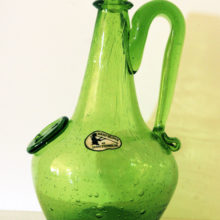
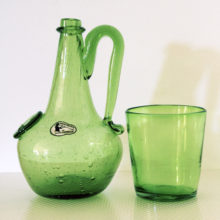
Early American style Jamestown Glass handled jug in bubbly glass with applied seal.
This old Jamestown Glass jug is a vintage reproduction of antique Early American glass made during the medieval revival of the 1960’s. It was heated at the furnace, blown by mouth and finished by hand with applied lip, handle and seal…just like glass makers did in the early days of American colonization.
The jug is full-size, just like you’d see on the American settlers tables or bars. Label still attached, reads – Hand Blown at Jamestown, VA. – The specialty ‘Jamestown’ line has been associated with Blenko Art Glass. Blenko created the line with inspiration provided by the early American Jamestown Glasshouse.
Loaded with bubbles, from extra tiny to long and stretched, as glass from early wood-burning furnaces have. Inverted soft pontil mark. Applied handle, lip and seal. The round disc on the front is a seal. Seals were often applied on glass made in America’s very early years.
Big jug is in excellent condition. Perfect for serving your home-made Sangria, etc. Beautiful sitting in a large window sill. Makes a great vase too. Measures 8.25″ tall and 5.5″ at widest. Weighs 2.5 lbs.
-
 $425.00
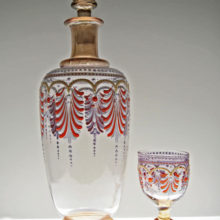
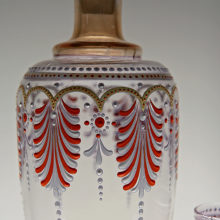
Antique enameled glass decanter and Goblet Signed L.
Well-preserved antique Bohemian glass hand-blown decanter and goblet with enamel decor . Very rare. Very old.
This antique decanter set is probably of Bohemian origin, possibly Joseph Lobmeyr or his son Ludwig (Vienna, Austria) . It is signed in gold with a notched cursive L preceded by a floating dot and followed by a period on the base of the decanter. May be of English origin, as the exact style of palm fan decor on these items match that used by Thomas Webb in the 1870’s. Victorian Era or older…has a Renaissance look to it.
To this date, we have not identified the “L” signature and we find that very odd! Perhaps it is not an “L”? If anyone can help with the ID, please email retroartglass@retroartglass.com. We have another antique decanter in emerald green with the “L”? makers mark, click here to view.
Heavy hand-painted enamel decor of drapes, dots and fans/palms of Islamic inspiration. The thick, bright orange, yellow and white enamel decor is absolutely perfect, 100%, no damage, no wear.
The translucent glass is light amethyst. The very faint purple tint to the glass may be the intention of the artist, but most likely due to a “sun purple” effect which would develop naturally over the decades. The glass glows light neon green under black light.
The hollow stopper (original to bottle), neck, hollow base and goblet stem are in gold luster. The luster shows some wear, some pinholes, some areas of lightening, but is 95% present. Great condition for its age. The small wine glass did not receive it’s final grinding on the outer foot edge, making the rim around the foot rough, not chipped. Fired polished rims are slightly uneven, expected from old hand-blown glass. The pontil scar is rough ground.
The decanter’s inner hollow base has some residue that will come out with further detailing. The glass has NO hazing or calcium deposits. No chips, no cracks.
Large decanter measures 11.5″ tall with stopper. Stemmed goblet is 4″ tall. Stopper and decanter neck are ground to fit. Stopper is hollow. Exceptional.
Victorian Glass Decanter Large with Handle, Stopper, Enamel Decor, Signed L.
-
 $45.00
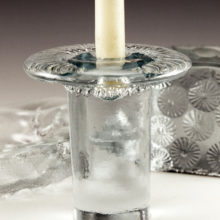
Blenko Art Glass Tall Mushroom Candlestick Holder with Original Sticker
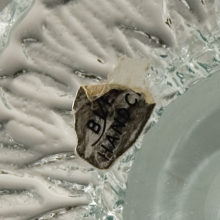
Big mushroom candlestick holder by Blenko Art Glass, circa 1970-1980. Remains of Blenko’s silver foil hand label still attached. This label was first used in the 1930’s and discontinued in 1982, but was used until the supply was deleted.
Shown in origional Blenko catalogs as part no. 77L, largest of three sizes available. Designed by Don Shepherd who worked at Blenko from 1974 to 1988.
Big, chunky colorless glass formed in wood or clay molds. The surface of the mushroom cap is smooth with the texture of the mushroom gills beneath.
Solid handmade mold-formed glass mushroom candlestick holder with no seam lines. Weighs 3 lbs. Fits the standard taper candlestick. Measures 5″ tall with a 5″ wide cap. In excellent condition.
-
SOLD
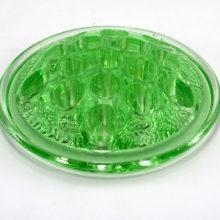
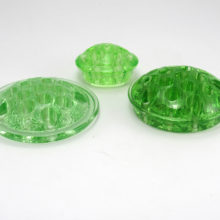
Large antique L.E. Smith Uranium glass flower frog was made in the 1920’s to 1930’s for assistance in flower arranging. The surface of the frog dome has little squiggly lines resembling hay. Made of Uranium glass which fluoresces bright glowing green under ultraviolet (black) light.The glass was created with Uranium to produce green colored glass at a time before Uranium was used for weapons. US production of Uranium glass ceased during World War II due to the US government’s confiscation of uranium supplies, and did not resume until 1958. After 1958, most Uranium glass objects were small figurines or reproductions of earlier antique forms. Read more about Uranium Glass.
This L.E. Smith Uranium glass flower frog was designed to sit upon the rim of your flower bowl or vase, allowing the flower stems to be inserted through the open holes reaching down into the water . It can be placed in the base of a bowl or vase if you’d like, as the rim will not prevent it, but it was specifically designed to float above the base of the vessel.
The L.E. Smith frog measures 4½” in diameter. The base is 4″ wide. Your flower vessel must have an 4″ wide opening for the frog to sit upon the rim. The frog has 16 holes. It is in perfect condition.
Most agree these helpful flower arranging tools were called ‘flower frogs’ because they sit in water, like a frog. Flower frogs became widely popular in the US during the early 1900’s for use in flower arranging. The form and function was replaced In the mid 1950’s by a water-absorbent foam, stopping the development of glass flower frogs.
Glass flower frogs of yesteryear are a better choice than modern foam as they are re-usable, sturdy, collectible and beautiful in their own way. Click here to learn how to use flower frogs.
Retro Art Glass has a wide variety of flower frogs available, including more made with Uranium, click here to view the selection.
-
 $45.00
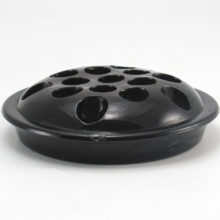
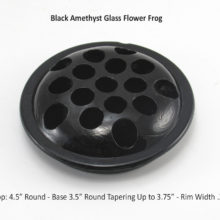
Large antique Black Amethyst glass flower frog was made in the 1920’s to 1930’s for assistance in flower arranging. It’s color is called Black Amethyst. It looks black, but is actually a very dark purple glass. In days gone by glass makers used dense purple or red glass to create black looking glass because they did not have a recipe for pure black glass.
This frog was designed to sit upon the rim of your flower bowl or vase, allowing the flower stems to be inserted through the open holes reaching down into the water . It can be placed in the base of a large bowl if you’d like, as the rim will not prevent it.
If you plan to use it as a rim balanced flower frog, your vessel opening rim must measure 3 ¼” to 4″ wide. The total width (diameter) of the round frog is 4½” wide. The frog rim is ¹⁄8″ inch wide. Stands 1¾” tall. The dome will rise above the level of the rim 1″. The flower stem holes are punched through (the punched through areas on the base reveal the true color, purple, when held to the light).
It weighs a tad over 1 lb. It is in great condition with one tiny sliver chip on the edge of the rim (view in image 1), no liquid stains.
Most agree these helpful flower arranging tools were called ‘flower frogs’ because they sit in water, like a frog. Flower frogs became widely popular in the US during the early 1900’s for use in flower arranging. The form and function was replaced In the mid 1950’s by a water-absorbent foam, stopping the development of glass flower frogs.
Glass flower frogs of yesteryear are a better choice than modern foam as they are re-usable, sturdy, collectible and beautiful in their own way. Click here to learn how to use flower frogs.
Retro Art Glass has a wide variety of flower frogs available, including more made with Uranium, click here to view the selection.
-
 $55.00
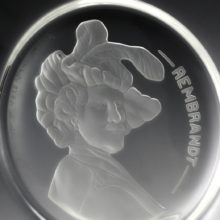
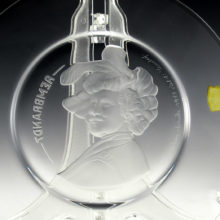
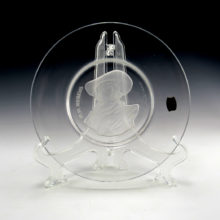
Rembrandt Portrait Etching Fine Belgium Crystal Signed & Dated 1968
Highly detailed Rembrandt portrait by Val St. Lambert, a producer of high quality art glass in Belgium. This plate is signed “Edition Limited, 1968, Val St. Lambert” in French.
This plate retains Both original labels. It is in excellent condition.
The Rembrandt portrait decor is deep acid etched from a very detailed carving. The surface of the plate is smooth, the deep etch decor shows through from the reverse. Wonderful 3-D effect. Beautiful artwork.
Heavyweight crystal, plate weighs 1.2 lbs. Measures 8″ wide, slightly flared rims .75″ deep. The Rembrandt plate does not have its original box.
Val St. Lambert made a series of these plates with different artists. Van Gogh and P.P. Rubens are shown in image 5 and are available separately. A gift set in its original packaging of Gainsborough and Reynolds is shown in image 6 and is also available separately.Click here to view all Old Masters portrait plates available.
-
 $55.00
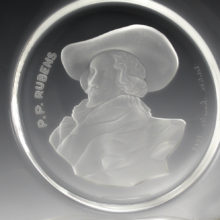
P.P. Rubens Portrait Plate in Quality Belgium Crystal with Deep Etching
Artistic P.P. Rubens Portrait Plate by Val St. Lambert. Signed & Dated 1968, Limited Series. From the quality glass maker’s ‘Old Masters’ series.
Val St. Lambert was a producer of high quality art glass in Belgium. Read more about the company at Wikipedia.
Peter Paul Rubens was a Baroque style portrait painter in the 1600’s.
The P.P. Rubens portrait decor is a very detailed deep acid etched carving. The surface of the plate is smooth, the deep etch decor shows through from the reverse. Wonderful 3-D effect. Beautiful artwork.
Heavyweight, high quality crystal plate weighs 1 lb. Measures 8″ wide, slightly flared rims .75″ deep. This plate retains its original label. It is in excellent condition.
Val St. Lambert made a series of these plates with different artists. Van Gogh and Rembrandt are shown in image 5 and are available separately. A gift set in its original packaging of Gainsborough and Reynolds is also available separately. Click here to view all Old Masters portrait plates available.
-
 $110.00
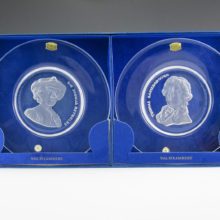
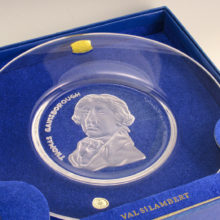
Old Masters Gift Set in High Quality Vintage Belgium Crystal
The Old Masters gift set includes two famous artists crystal art plates by Val Saint Lambert, Belgium. Highly artistic deep sand-blast carvings on quality crystal of English artists Sir Joshua Reynolds and Thomas Gainsborough. Both men were competing in the lucrative portrait business in the Mid-18th Century
Great find in original box with literature. Box is a bit worn from storage. Plates are in pristine condition with both Val St. Lambert labels on each.
The carvings are detailed and interesting/amusing. Artist must have been very grumpy back in the 1700’s. Top-of-the line deeply etched decor with a fascinating 3-D effect.
The crystal is pure, extreme high clarity…not a spot on it. Thick walled, top-quality Belgium crystal.
Both are signed on the base “Edition Limited – 1972 Val St. Lambert”. Pamphlet gives a short bio of the artists and a list (with dates) of others artists in the series beginning in 1968.
More famous artist plates of Van Gogh, Rubens and Rembrandt (without original boxes) are available separately . Click here to view all Old Masters portrait plates available.
Plates measure 8″ round, rims are slightly flared up. Each plate weighs 1 lb.
Read more about Val Saint Lambert at Wikipedia…
Read more about Bohemian Glass -
 $45.00
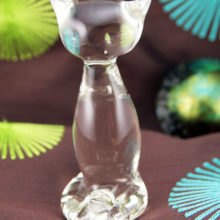
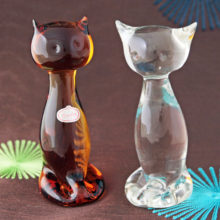
Rainbow Art Glass Crystal Cat Figurine
Mid-century modern stylized crystal cat figurine in colorless glass. Made in the 1960’s by Rainbow Art Glass, USA.
Hand-formed with pulled ears and pinched eyes. The ‘tail’ is wrapped around its feet. Retro modern style.
Solid glass weighs 1 lb. Stands 5½” tall. In like-new condition. Perfect gift for your favorite cat lover. Other Rainbow art glass items shown in images may be available separately.
-
 $75.00
SOLD
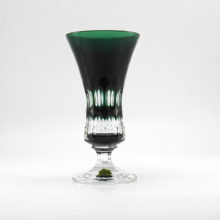
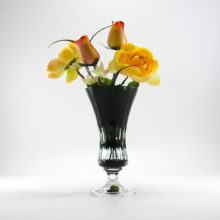
Val Saint Lambert Emerald Cut to Crystal Vase with Maker’s Label
Heavy crystal vase by Val Saint Lambert of Belgium. Made with quality colorless crystal with a layer of emerald green crystal. The decor was achieved by removing the green crystal revealing a pattern in colorless crystal.
Val St. Lambert sticker still attached. In perfect condition. Measures 7½” tall with a 3¾” wide flared bowl. Weighs 1½ lbs. Estimated circa 1970 – 1990.
Beautiful, well-made quality vase made with authentic lead crystal. Perfect gift, including flowers, for that special someone.
Val St. Lambert was founded in Belgium, in 1826.
-
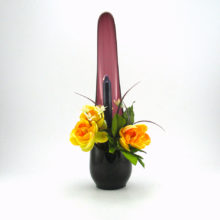
SOLD
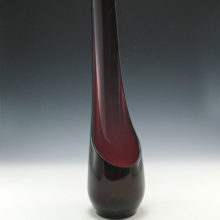
Tall Retro Modern Decor Candle Vase Vintage Hand-Made in Amethyst Glass
Graceful and tall retro modern decor hand-stretched candle vase by Viking Art Glass or New Martinsville. New Martinsville Glass was the original company later known as Viking Art Glass.
We believe this candle vase was probably made by New Martinsville because of the ground and polished base ring and pontil scar. Viking didn’t pay as much attention to detail as did its predecessor. Dates to the early 1950’s. This form was continued by the company until the early 1970’s.
It’s big and beautiful. Measures 17″ tall. Inside the bowl at the base is a ¾” wide taper candle receiver. Surrounding the receiver is an large enough area to insert flowers, foliage, etc.
In perfect condition. Made by hand, blown into mold, stretched by hand. Lovely dark amethyst color in thick-walled glass.