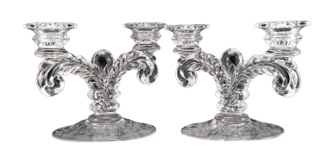
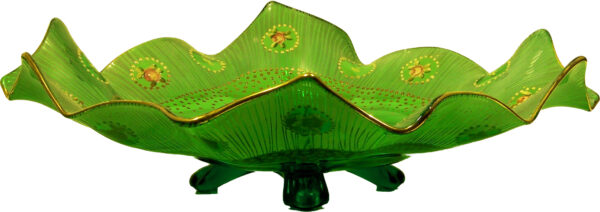
The Cambridge Glass Company, established in 1901 in Cambridge, Ohio, was one of the premier producers of luxury “Elegant Glass” in America. While mass-production factories manufactured cheap, machine-molded Depression glass, Cambridge specialized in premium, hand-blown glassware. Under the long-term leadership of Arthur J. Bennett, the company shifted toward high-end art glass featuring intricate acid etchings, vibrant custom colors, and gold-encrusted designs. Despite its global prestige, intense competition from foreign labor and automated machinery forced the factory to close permanently in 1958.
The company’s world-class chemists created legendary, innovative colors. These included Crown Tuscan, a silky opaque pink, and Heatherbloom, a rare neodymium glass that dynamically shifted color from lavender under indoor light to pink in natural sunlight.
Cambridge was prolific, but a few iconic lines stand out in American design history:
- Rose Point: Introduced in 1934, this is the company’s most famous pattern, featuring an extraordinarily detailed, delicate lace and rose motif.
- Caprice: A modern, sensational line that relied on a fluid, rippling wave pattern to manipulate light, most famously produced in Moonlight Blue.
- Statuesque (Nude Stems): A highly distinct line of stemware where the traditional glass pedestal leg was replaced by a frosted figurine of a nude woman.
- Nearcut: An early 1900s pressed glass technique that beautifully mimicked expensive, heavy imported European deep-cut crystal.