Rainbow Art Glass Company (1940–1983)
History & Production:
The Rainbow Art Glass Company was originally founded in 1940 in Long Island City, New York, by J. Goudaker (President) and Henry P. Manus (Vice President) before relocating to Huntington, West Virginia, in 1942. During its first decade in Huntington, Rainbow operated strictly as a decorating studio, purchasing glass blanks from other factories and embellishing them with hand-painted, stained, and enameled designs.
In 1954, Rainbow began manufacturing its own handblown decorative glass at its 1500 Adams Avenue plant, quickly becoming known for vibrant mid-century colors, bold silhouettes, and crackle finishes. In 1973, the company was purchased as a subsidiary by the Viking Glass Company of New Martinsville, operating as Rainbow-Viking Glass. On August 30, 1983, a devastating fire destroyed the Huntington factory and adjacent retail shop. Viking chose not to rebuild, bringing Rainbow’s Huntington production to a permanent close.
- In-House Glassblowing Team: Rainbow relied on skilled local and immigrant glassblowers recruited from the Ohio Valley glass belt to create free-form sculptural pieces, pitchers, and decanters.
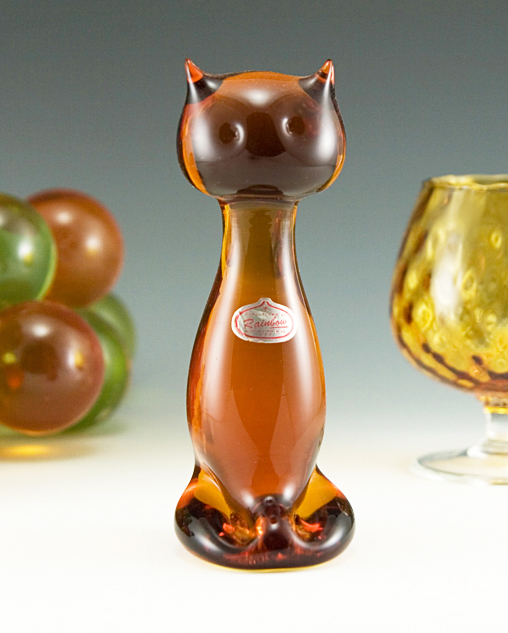
- Signature Colors & Finishes: Collectors prize Rainbow’s rich mid-century palette, particularly Tangerina (fiery orange-red), Amberina (graduated ruby-to-amber), ruby, cobalt blue, emerald-green, and amber. Rainbow is remembered for their crackle glass and line of hand-formed miniature animals and figurines
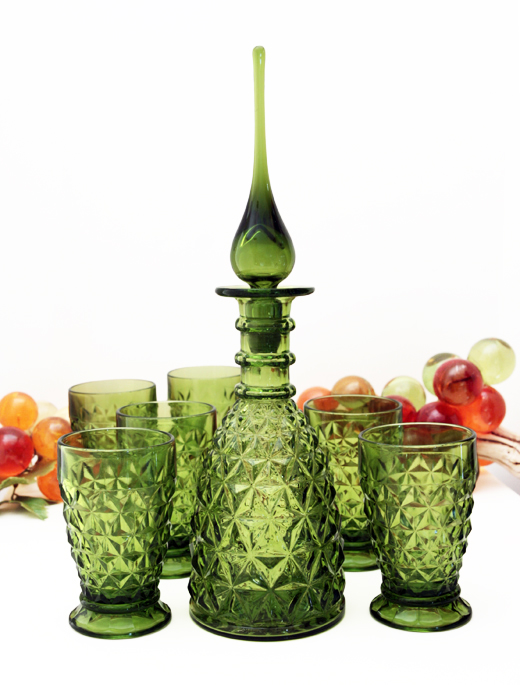
- Stoppers & Flat Collars: Rainbow decanters are frequently identified by their distinct flat-collar bottlenecks paired with large, hollow round or flame-shaped stoppers.
- Rainbow vs. Viking Labels: Like many West Virginia glassmakers, Rainbow did not mold its name into the glass, relying instead on paper and foil stickers (such as the classic multicolored “Rainbow Hand Blown” label). After the 1973 buyout, Viking continued making many popular Rainbow molds—meaning you can often find classic Rainbow crackle decanters and animal figurines bearing Viking Glass foil labels.
- Telling Rainbow Apart from Blenko & Pilgrim: Because Rainbow, Blenko, and Pilgrim all operated within a few miles of each other and produced similar collectors should check the proportions and finish. Rainbow pieces tend to be slightly smaller and lighter in weight than Blenko’s heavy, architectural forms, and their crackle texture is often finer and more uniform.
- The “Rainbow Import” Connection. While Rainbow Art Glass was famous for blowing its own free-form glass in Huntington, West Virginia, the company also operated an import division during the 1960s. Rainbow imported mold-blown glassware—primarily from Empoli, Italy (and occasionally Japan or Taiwan)—and applied their own foil retail labels before distributing them to American department and gift stores.