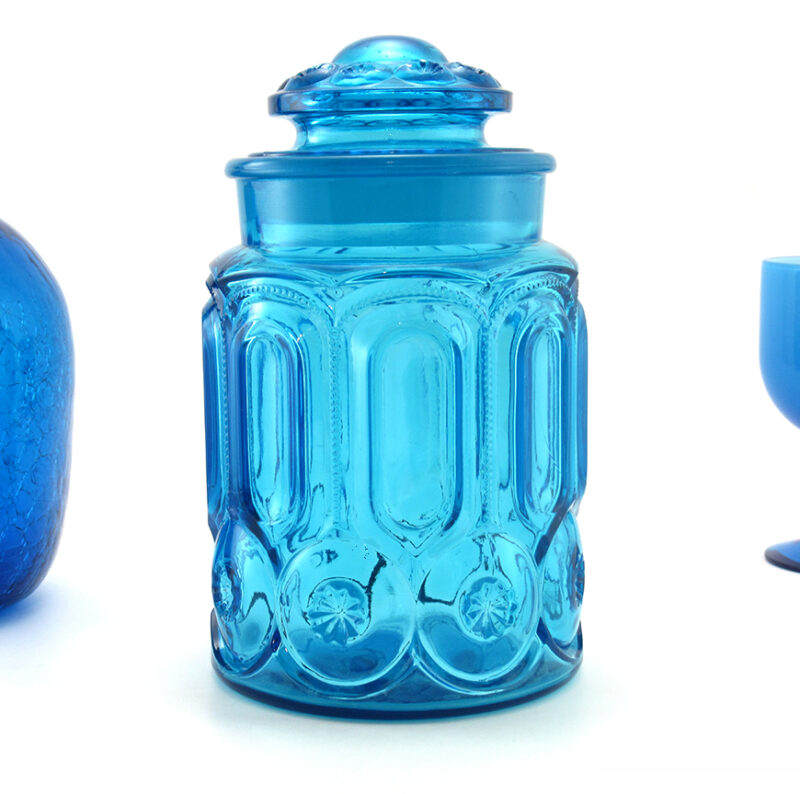
L.E. Smith Glass Company (1907–2005)
Founded in 1907 in Jeannette, Pennsylvania, by Louis E. “Lew” Smith—and settling permanently in Mount Pleasant, Pennsylvania, in 1909—the L.E. Smith Glass Company produced American glassware for nearly a century. In its earliest years, the factory manufactured utilitarian goods ranging from mustard and jelly jars to the first glass headlight lenses for Henry Ford’s Model T. By the 1920s and 1930s, Smith expanded into colorful Depression-era tableware (such as the Mount Pleasant / Double Shield pattern), novelty figural items, milk glass, and decorative bookends—including its well-known rearing horse bookends, which closely resemble a contemporary Fostoria design.
Smith is especially famous for its extensive production of the “Moon & Star” pattern. Originally introduced in the 1880s as “Palace” by Adams & Co., the motif was revived in the mid-20th century by several makers—most notably L.G. Wright and L.E. Smith (which began leasing molds from the Island Mould Company in 1962), alongside variations by Fenton. Smith produced Moon & Star in rich shades of Amberina, Colonial Blue, Emerald Green, Ruby, Amber, and Amethyst.
During the 1960s and 1970s, L.E. Smith became a powerhouse of Mid-Century Modern decor. Its iconic “Simplicity” line featured dramatic, hand-pulled swung vases—including collector-favorite “Fat Bottom,” “Smoothie,” and ribbed floor vases reaching over two feet tall—in glowing colors like Bittersweet (cadmium orange-red), Persimmon, Peacock Blue, Lime Green, and Honey Amber. Smith also acquired molds from McKee and Imperial, producing revival Carnival Glass and commemorative plates after being purchased by Owens-Illinois in the 1970s. Following bankruptcy in 2004, the historic Mount Pleasant factory closed permanently in early 2005.
Collector Identification Note: True to your original note, a large percentage of L.E. Smith glass was left unmarked—especially mid-century swung vases and Moon & Star pieces, which relied on foil paper labels. However, on pieces made from the 1970s onward (particularly revival Carnival Glass), look for an embossed capital “S” containing a small “G” in the top loop and a small “C” in the bottom loop.