Late 1920s to Early 1940s
During the Great Depression, American glassmakers faced a major challenge: producing attractive, affordable tableware for cash-strapped families. By using automated pressing machines and inexpensive raw materials, factories mass-produced colorful dishes that brought a touch of cheer to everyday dining tables. Because speed and low cost were prioritized over perfection, the glass developed distinct manufacturing quirks that collectors now recognize as hallmarks of the era.
The most familiar Depression glass was rarely bought as a complete set. Instead, it was widely distributed as a free promotional premium inside boxes of laundry detergent and bags of flour or oats, at gas stations, and during “Dish Night” giveaways at local movie theaters. Complete place settings and individual pieces were also sold cheaply at five-and-dime stores like Woolworth’s. Major manufacturers of this everyday machine-made ware included Anchor Hocking, Hazel-Atlas, Jeannette, Federal, Indiana Glass, and MacBeth-Evans
According to the Glass Encyclopedia, “Sometimes the quality of the glass was less than perfect. Often there were mold flaws. Sometimes the straw on which the hot glass was set to cool would leave an indentation called a ‘straw mark’ in the glass. Unless the flaw is major it doesn’t affect the value or beauty of the glass and [collectors] still consider the glass to be perfect.” Along with straw marks, tiny trapped air bubbles and visible mold seams are normal traits of authentic pieces.
Alongside everyday machine-pressed glass, factories also produced “Elegant Depression Glass.” Made largely by hand and finished with acid-etching or wheel-cutting by companies such as Cambridge, Fostoria, Heisey, Tiffin, and New Martinsville, elegant glass was sold in upscale department and jewelry stores. It featured clearer crystal, sharper patterns, and higher overall quality than giveaway glassware.
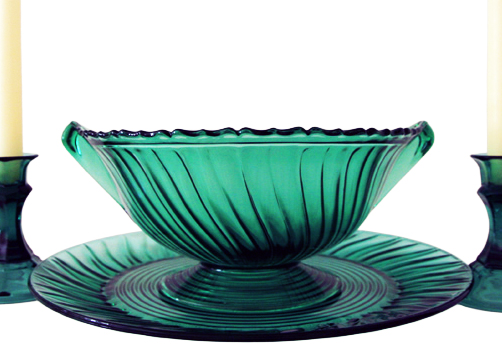
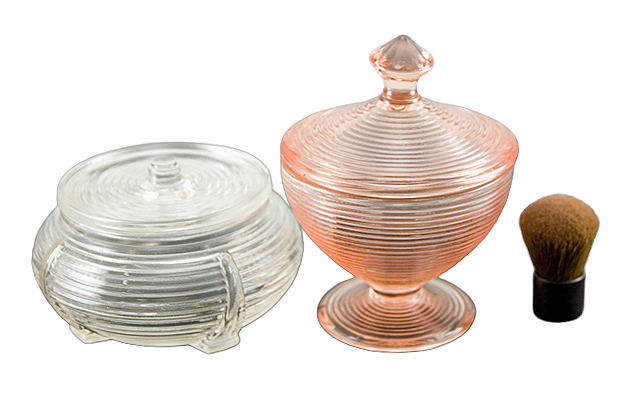
Colors & Collector Beware: While pink and green (often made with trace uranium that glows bright green under a UV blacklight) are the most iconic and widely collected colors, Depression glass was also made in amber, crystal, cobalt blue, yellow, delphite, and black. Because of its enduring popularity, many classic patterns have been reproduced since the 1970s. Collectors should check pattern details, weight, and mold sharpness carefully, as modern reproductions—and even vintage reproductions—remain common on the market.