Westmoreland Glass Company (1889–1984)
History & Production:
The Westmoreland Glass Company began in 1889 when brothers George R. and Charles H. West, along with financial backer Ira Brainard, purchased the Specialty Glass Company of East Liverpool, Ohio, and relocated it to Grapeville, Pennsylvania. Drawn to Western Pennsylvania by abundant natural gas reserves and railroad access, the firm initially operated as the Westmoreland Specialty Company before officially adopting the Westmoreland Glass Company name in the early 1920s. In its early decades, the factory became famous for pressed tableware, novelty glass candy containers, and mustard jars—earning Charles West the nickname “Father of the Candy Container Industry”.
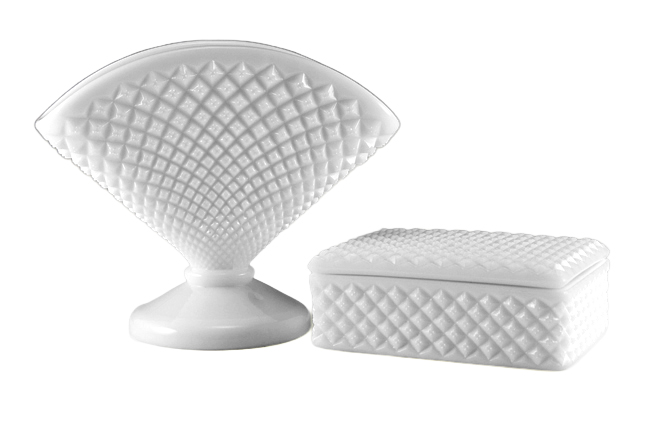
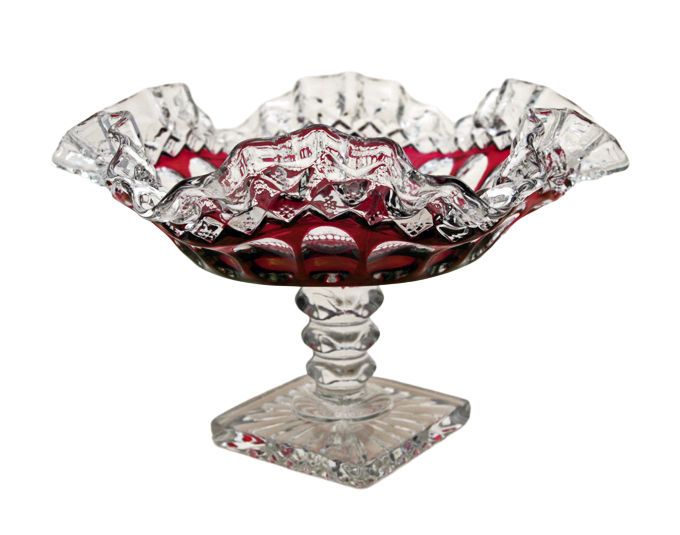
During the 1920s and 1930s, Westmoreland entered a golden era of ornate, hand-decorated crystal and colored glass. Following the Brainard family’s buyout of the West brothers’ interest in 1937, the company pivoted toward reproducing 19th-century Early American pressed glass patterns. By the late 1940s and 1950s, Westmoreland became America’s premier producer of milk glass, which accounted for roughly 90% of its output at its peak. Facing rising labor costs and overseas competition, the Brainard family sold the business to David Grossman in the early 1980s, and the Grapeville plant permanently closed its doors in January 1984.
Patterns & Signature Lines:
- Iconic molded Patterns: Westmoreland’s deeply sculpted pressed patterns, most notably Paneled Grape, Old Quilt, Beaded Grape, English Hobnail, Doric, Roses and Bows, and Thousand Eye.
- Covered Animal Dishes & Novelties: Westmoreland produced a menagerie of covered animal dishes (such as Hens on a Nest, roosters, cats, and rabbits), miniature punch sets, and fairy lamps.
Collector’s Tips & Identification:
- Evolution of Trademarks: Westmoreland used several molded trademarks over its history. Early pieces (circa 1912–1920s) often feature a letter “W” inside a keystone. Starting in 1946, the company introduced its most famous mark—an interlocking “W” and “G” embossed on the underside. Late-era pieces made under David Grossman (1982–1984) carry a “Westmoreland” semicircle over a “W”.
- Unmarked Pieces & Milk Glass Quality: Because many Westmoreland items were sold only with paper foil labels, unmarked pieces are common. Authentic Westmoreland milk glass is exceptionally dense, heavy, and opaque, featuring a crisp, “cold” white tone with sharp mold detailing.
- Specialty Finishes & Colors: Beyond pure milk glass, Westmoreland produced slag glass (marbled caramel, purple, and green), carnival glass, Vaseline/uranium glass, and hand-painted pieces signed on the base by factory decorators.
- Beware of Post-1984 Reissues: After the factory closed in 1984, many original Westmoreland molds were sold to companies like Mosser Glass, Rosso, and Plum Glass (founded by former Westmoreland workers, who used a “P” inside a keystone mark).